

Real Estate Becomes a Core Pillar of Vietnam’s New Economic Growth Strategy
At the Vietnam Real Estate Forum 2026, held under the theme “The Real Estate Market in a New Growth Model: Unlocking Resources – Creating Development Space – Supporting National Growth Objectives,” industry experts, policymakers, and business leaders emphasized a crucial message: the real estate market is no longer merely an asset market but an integral component of Vietnam’s new economic growth model.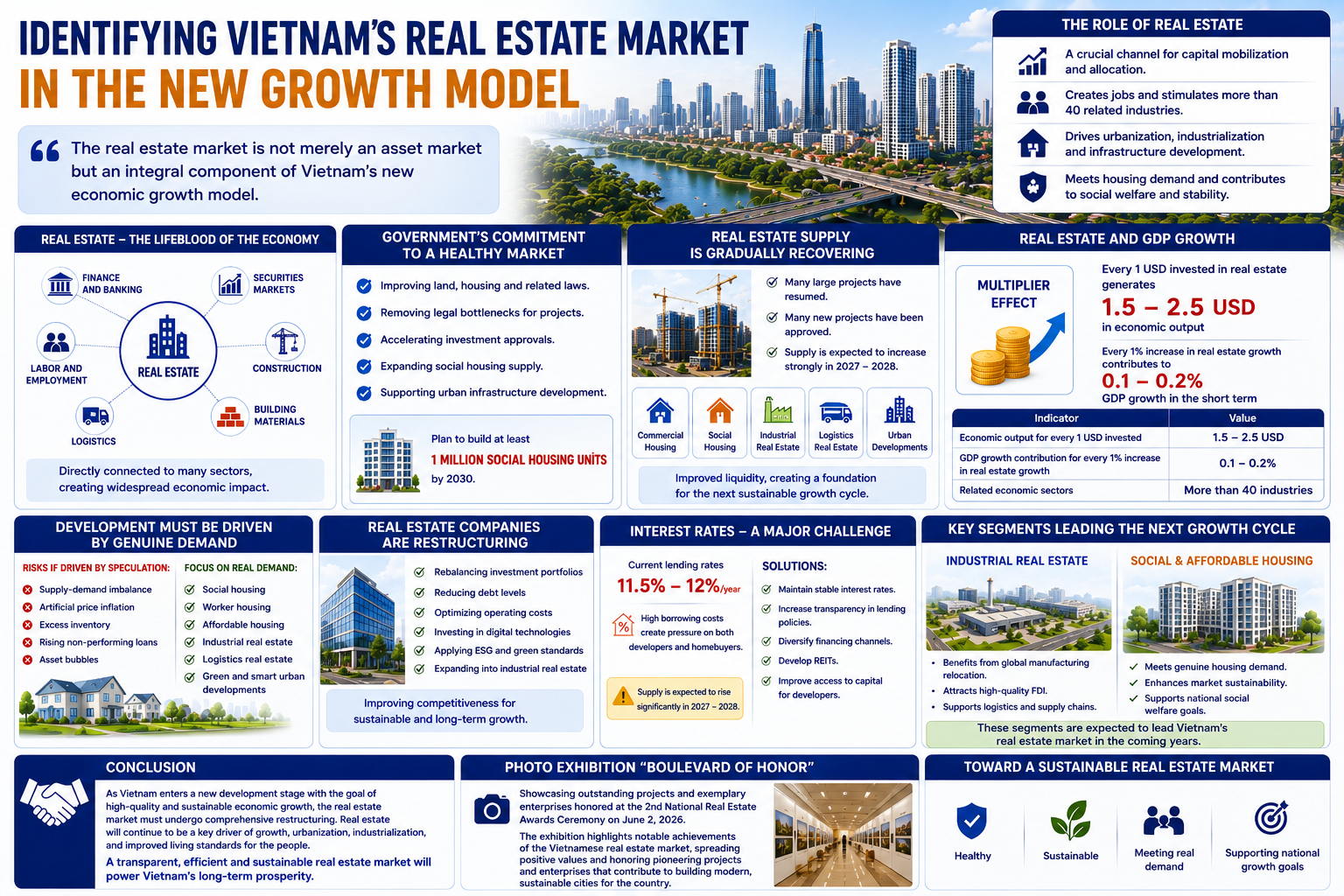
As the country aims for sustainable high-growth development and ambitious economic targets, real estate is increasingly viewed as a strategic sector capable of mobilizing resources, expanding development space, and accelerating urbanization and industrialization.
Real Estate: The Lifeblood of the Economy
According to experts at the forum, the real estate sector maintains strong connections with numerous key economic industries, including:
- Banking and finance
- Securities markets
- Construction
- Building materials
- Logistics
- Manufacturing and industry
- Labor and employment
The development of real estate projects not only generates direct economic value but also stimulates growth across multiple related sectors.
Moreover, real estate serves as an efficient channel for mobilizing and allocating capital to infrastructure projects, industrial parks, urban developments, and housing initiatives.
Government Committed to Building a Healthy and Sustainable Market
Deputy Minister of Construction Nguyen Van Sinh highlighted the Government’s determination to promote a stable, transparent, and sustainable real estate market.
Recent policy measures include:
- Improving land and housing legislation.
- Removing legal obstacles for real estate projects.
- Accelerating project approvals.
- Expanding social housing programs.
- Supporting urban infrastructure development.
A notable initiative is Vietnam’s plan to build at least one million social housing units by 2030, helping to increase housing supply while addressing citizens’ housing needs.
Real Estate Supply Is Gradually Recovering
Following a prolonged period of challenges, Vietnam’s real estate market is showing encouraging signs of recovery.
Numerous large-scale projects have resumed construction, while many new developments have received investment approval, laying the foundation for a new growth cycle.
Industry analysts expect a significant increase in supply between 2027 and 2028 across key segments such as:
- Commercial housing
- Social housing
- Industrial real estate
- Logistics real estate
- Integrated urban developments
This recovery is expected to improve market liquidity and support long-term sustainable growth.
Real Estate as a Driver of GDP Growth
Professor Hoang Van Cuong, Vice Chairman of the Vietnam Economic Science Association, noted that real estate is one of the sectors with the strongest ability to absorb capital and generate widespread economic impact.
Research presented at the forum indicates:
Economic Impact of Real Estate
| Indicator | Value |
|---|---|
| Additional economic output generated by every USD invested in real estate | USD 1.5 – 2.5 |
| GDP growth generated by every 1% increase in real estate growth | 0.1% – 0.2% |
| Related economic sectors | More than 40 industries |
In the short term, real estate and infrastructure remain among the fastest and most effective sectors for stimulating economic growth.
By contrast, science and technology investments often require 5–10 years before generating significant economic returns.
Real Estate Development Must Be Driven by Genuine Demand
Experts also warned against excessive speculation in the property market.
If real estate is primarily purchased for asset accumulation rather than actual use, it may create several risks, including:
- Supply-demand imbalances
- Artificial price inflation
- Excess inventory
- Rising non-performing loans
- Asset bubbles
Therefore, future development should prioritize segments with genuine demand, including:
- Social housing
- Worker housing
- Affordable housing
- Industrial real estate
- Logistics properties
- Green and smart urban developments
Real Estate Companies Undergoing Major Restructuring
According to Nguyen Toan, Vice Chairman of the Vietnam Real Estate Association, the market is entering a new development cycle characterized by stricter standards and greater transparency.
Business models heavily dependent on financial leverage have exposed significant risks in recent years.
As a result, many developers are implementing restructuring strategies such as:
- Rebalancing investment portfolios
- Reducing debt levels
- Optimizing operational costs
- Investing in digital technologies
- Applying ESG and green standards
- Expanding into industrial real estate
These changes are helping businesses improve competitiveness and build sustainable growth models.
Interest Rates Remain a Major Challenge
One of the most pressing issues facing the market today is the cost of capital.
According to industry representatives, real estate lending rates currently range between 11.5% and 12% per year, creating significant pressure on both developers and homebuyers.
At the same time, market supply is expected to rise substantially during 2027–2028.
Experts therefore recommend:
- Maintaining stable interest rates
- Enhancing transparency in lending policies
- Expanding non-bank financing channels
- Developing Real Estate Investment Trusts (REITs)
- Improving access to capital for developers
These measures are considered essential for supporting a sustainable market recovery.
Industrial Real Estate and Social Housing Will Lead the Next Growth Cycle
Under Vietnam’s new growth model, experts identify two key segments with the strongest long-term potential:
Industrial Real Estate
- Benefits from global manufacturing relocation trends
- Attracts high-quality foreign direct investment (FDI)
- Supports logistics and supply chain development
Social and Affordable Housing
- Meets genuine housing demand
- Enhances market sustainability
- Supports national social welfare objectives
These segments are expected to become the primary growth drivers of Vietnam’s real estate market in the coming years.
Conclusion
As Vietnam enters a new phase of development focused on high-quality and sustainable economic growth, the real estate market faces the need for comprehensive restructuring. Beyond serving as an investment channel or asset class, real estate must become a catalyst for economic development, urbanization, industrialization, and improved living standards. With continued support from the Government, businesses, and investors, Vietnam’s real estate market is expected to enter a new era characterized by greater transparency, efficiency, resilience, and sustainable growth.
References:
Free access to exclusive information on warehouse, factory, and land rentals in Dong Nai, Binh Duong, Long An, Ho Chi Minh City, and more.
KHU CÔNG NGHIỆP 247 is a company operating in the field of buying, selling, and leasing factories and real estate.. We are proud to be a leading provider of real estate services in Vietnam. We have a team of highly qualified and experienced real estate consultants who always place trust and credibility at the core of everything we do.
Phone: 0901 490 348
Email: datkhucongnghiep247@gmail.com
Website: datkhucongnghiep247.com.vn