

Industrial real estate stocks are going through a sharp correction after delivering strong gains in previous years. Many major stocks in the sector are now trading 30% to 65% below their historical peaks, while foreign direct investment (FDI) into Vietnam continues to record positive growth.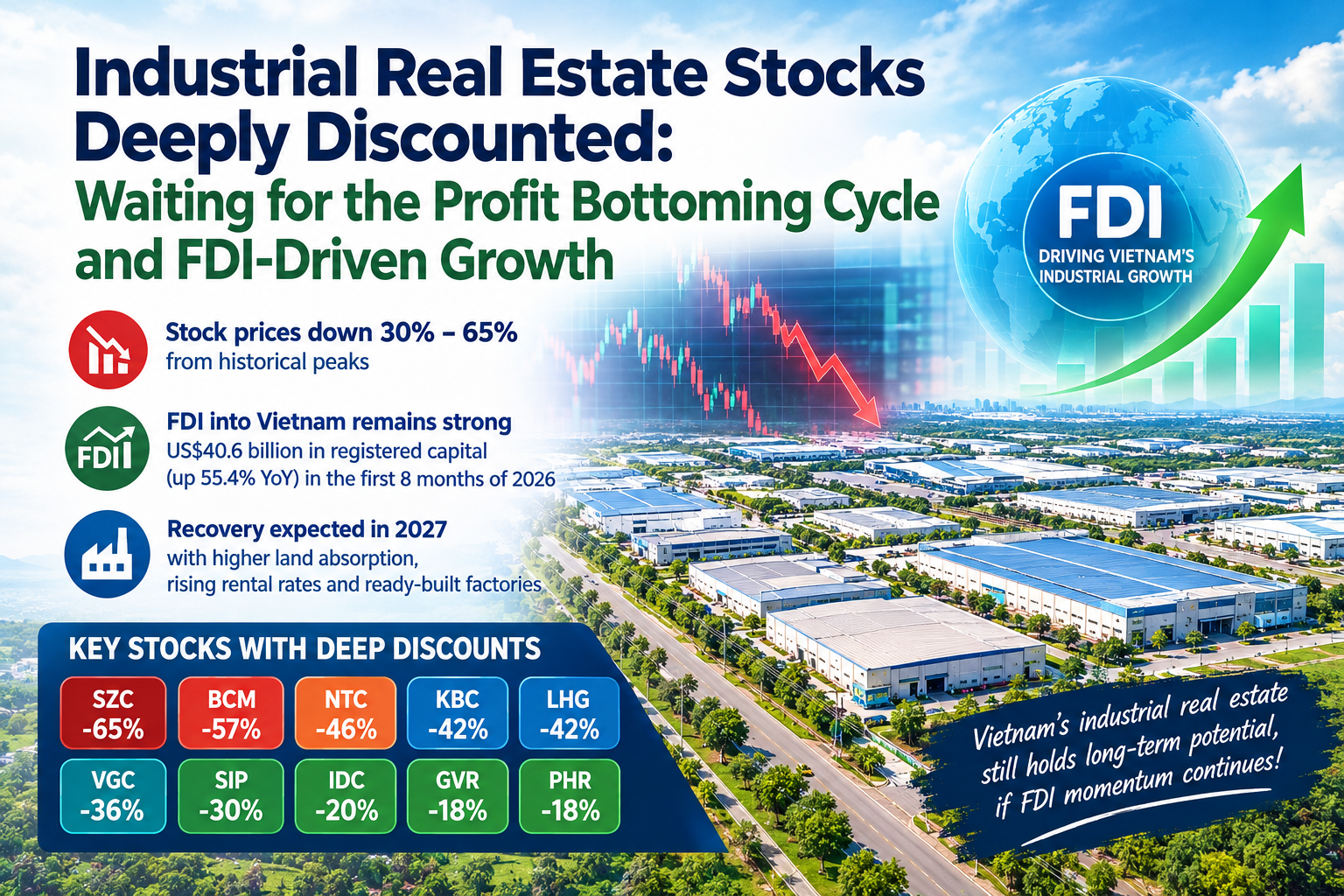
The divergence between stock prices and the industry’s long-term outlook raises an important question: are industrial real estate stocks already pricing in current challenges, or is the market entering a period of preparation for a new growth cycle?
Factors such as FDI inflows, industrial land absorption, available land ready for leasing, project legal progress, ready-built factories and high-tech manufacturing investment are expected to play an important role in determining the industry’s outlook for 2026-2027.
Industrial Real Estate Stocks Fall Sharply From Their Peaks
The stock market shows that industrial real estate stocks have undergone a significant correction from their previous highs.
As of the end of the trading session on September 18, 2026, several representative stocks had recorded substantial declines:
| Stock | Decline from Peak |
|---|---|
| SZC | approximately 65% |
| BCM | approximately 57% |
| NTC | approximately 46% |
| KBC | approximately 42% |
| LHG | approximately 42% |
| VGC | approximately 36% |
| SIP | approximately 30% |
| IDC | approximately 20% |
| GVR | approximately 18% |
| PHR | approximately 18% |
These declines indicate that market expectations for industrial real estate stocks have changed significantly compared with the 2024-2025 period.
However, a decline in stock prices does not necessarily mean that the industry’s operating outlook has deteriorated by the same magnitude.
This is an important point when evaluating Vietnam industrial real estate stocks in 2026.
The Divergence Between Stock Prices and FDI Inflows
One of the most notable developments is the divergence between industrial real estate stock performance and foreign direct investment flows.
According to the figures cited in the analysis, during the first eight months of 2026, total registered FDI into Vietnam reached approximately US$40.6 billion, up 55.4% year on year.
Meanwhile, disbursed FDI reached approximately US$17.3 billion, representing an increase of around 12%.
These figures indicate that foreign investment demand for manufacturing activities in Vietnam remains relatively strong.
For the industrial real estate market, FDI plays a particularly important role because foreign manufacturers typically require:
- Industrial land.
- Ready-built factories.
- Logistics warehouses.
- Distribution centers.
- Build-to-suit factories.
- Industrial infrastructure and utilities.
- Electricity and water services.
- Wastewater treatment facilities.
- Supporting services for manufacturing operations.
Therefore, continued FDI growth remains one of the key long-term drivers of the Vietnam industrial property market.
However, rising FDI does not necessarily translate immediately into higher revenue and profits for industrial property developers.
This is directly related to the time lag between FDI inflows and corporate earnings.
Why Are Industrial Real Estate Stocks Falling Despite Strong FDI Growth?
Several factors help explain this apparent contradiction.
The Time Lag in Converting Land Reserves Into Revenue
For an industrial park developer, owning a large land bank is only the first step.
To convert land reserves into revenue and profits, developers generally need to go through multiple stages:
Land bank → legal approvals → site clearance → infrastructure development → tenant acquisition → lease agreement → land handover → revenue recognition → cash collection.
As a result, higher FDI in 2026 does not necessarily translate into higher profits within the same year.
This is one reason why companies such as IDC, VGC and SZC may face pressure if land handovers fall short of expectations, while new projects continue to require additional time for legal procedures and infrastructure development.
Could 2026 Mark the Profit Bottom for the Industry?
One of the key investment themes for industrial real estate is the possibility that 2026 could mark the industry’s earnings bottom, followed by a more visible recovery from 2027.
During previous periods, many industrial park developers benefited significantly from land handovers.
However, when previously contracted land has not yet met the conditions for revenue recognition, earnings can come under short-term pressure.
At the same time, new projects require time to complete:
- Investment procedures.
- Planning approvals.
- Site clearance.
- Compensation.
- Infrastructure construction.
- Tenant acquisition.
- Lease agreements.
- Land handovers.
This time lag creates a gap between the industry’s long-term growth prospects and the short-term earnings performance of individual companies.
If industrial land absorption continues to improve in 2026, companies with readily available industrial land could enter a new growth cycle during 2027-2028.
Vietcap Forecasts a Recovery in Industrial Land Leasing
According to views presented at seminars organized by Vietcap Securities (VCI), industrial land absorption began improving from late 2025 and maintained a positive trend during the first half of 2026.
Vietcap forecasts that FDI could increase by approximately 9% during the remaining months of 2026 and in 2027.
Notably, total industrial land leasing sales among industrial park developers are projected to:
- Increase by approximately 25% in 2026.
- Increase by another 22% in 2027.
If this scenario materializes, the market could see a significant improvement in new leasing contracts and revenue among companies with large industrial land reserves.
However, the pace of recovery is unlikely to be uniform.
Companies with clean land, completed legal procedures and favorable locations may benefit earlier than those still dependent on site clearance or lengthy legal processes.
IDC: Stable Cash Flow and New Industrial Land Projects
IDICO Corporation (IDC) is one of the notable companies in Vietnam’s industrial real estate sector.
According to the information cited in the analysis, IDC targets approximately 100 hectares of industrial land leasing sales in 2026, primarily from projects such as Vinh Quang and Tan Phuoc 1.
Another notable feature is the company’s cash dividend policy, with a dividend yield cited at approximately 10%.
For investors monitoring industrial real estate stocks, IDC is often associated with:
- Industrial land reserves.
- Industrial park cash flow.
- Infrastructure assets.
- New project development potential.
- A notable cash dividend policy.
IDC’s outlook will depend heavily on the implementation progress of new projects and its ability to convert land reserves into actual revenue.
KBC: Expectations From Land Awaiting Handover and Urban Development
Kinh Bac City Development Corporation (KBC) is another major name in Vietnam’s industrial real estate sector.
According to the information cited, the company has approximately 170 hectares of land awaiting handover to major partners, including large technology and manufacturing companies such as LG and Foxconn.
If handover schedules proceed smoothly, this land bank could make a significant contribution to revenue and earnings.
Beyond industrial parks, the market also expects urban development projects to become a new growth driver for KBC from 2027.
As a result, KBC’s investment story is not limited to industrial land leasing but also involves the company’s ability to develop large-scale urban projects.
VGC: Advantages From Industrial Land and Building Materials
Viglacera Corporation (VGC) operates a relatively diversified business model, with activities spanning both industrial parks and building materials.
According to the cited information, VGC has approximately 1,800 hectares of industrial land ready for leasing.
A large land bank gives the company room to capture demand as FDI inflows continue to increase.
In addition to industrial real estate, the building materials segment is also an important contributor to VGC’s earnings.
The implementation of anti-dumping measures could change the competitive environment in the building materials market.
Therefore, VGC’s outlook should be considered through two major business pillars:
Industrial real estate + Building materials.
SIP: Recurring Revenue From Utilities and Ready-Built Factories
Saigon VRG Investment Corporation (SIP) has a business model that differs from some traditional industrial park developers.
In addition to industrial land leasing, SIP generates revenue from:
- Industrial park infrastructure.
- Electricity and water.
- Utility services.
- Ready-built factories.
- Supporting services for industrial tenants.
According to the cited forecasts, revenue from industrial utilities and ready-built factories could average approximately VND1 trillion per year during 2026-2027.
This model provides SIP with additional recurring revenue alongside traditional industrial land leasing activities.
It is also increasingly relevant as FDI manufacturers seek ready-built factories to shorten project implementation and production start-up times.
PHR: An Earnings Story Beyond Industrial Land Leasing
Phuoc Hoa Rubber Joint Stock Company (PHR) represents a somewhat different investment story.
PHR’s earnings drivers are not entirely dependent on industrial land leasing.
The company may also benefit from income related to compensation and land conversion associated with projects such as VSIP III and Bac Tan Uyen 1.
Over the long term, its large rubber plantation land bank and potential conversion into industrial land also represent an important source of future value.
Therefore, when assessing PHR, investors need to distinguish between:
The rubber business
and
the potential value from converting rubber plantation land into industrial development.
These two sources of value may have very different timelines for revenue and profit recognition.
SZC and the Industrial Land Bank Story
Sonadezi Chau Duc Corporation (SZC) is one of the stocks that has experienced the sharpest correction among the companies discussed.
A decline of approximately 65% from its peak shows how significantly market expectations for the stock have changed.
However, evaluating an industrial park developer should not rely solely on stock price performance.
Key factors to monitor include:
- Remaining leasable industrial land.
- Average leasing prices.
- Occupancy rates.
- Site clearance progress.
- Infrastructure construction progress.
- Major tenants.
- New leasing sales.
- Land handover volume.
- Revenue recognition timing.
- Cash flow from customers.
These indicators can provide a more direct view of the underlying operating performance of an industrial real estate company.
FDI and Industrial Land Demand: Long-Term Drivers Remain Intact
One of the most important foundations of Vietnam’s industrial real estate market is the ongoing restructuring and diversification of global supply chains.
Vietnam continues to attract international manufacturers, particularly in sectors such as:
- Electronics.
- Semiconductors.
- Electrical equipment.
- Precision engineering.
- Supporting industries.
- Logistics.
- Pharmaceuticals.
- High technology.
- Energy.
- Component manufacturing.
As new FDI projects are implemented, demand for industrial land and factories also increases.
In particular, the ready-built factory (RBF) model is becoming increasingly attractive to companies seeking to shorten the time required to establish manufacturing operations.
This creates a new growth avenue alongside the traditional industrial land leasing model.
Ready-Built Factories Are Becoming an Important Trend
As foreign manufacturers increasingly prioritize speed to market, ready-built factories could become an increasingly important segment of Vietnam’s industrial real estate market.
Instead of spending significant time on:
Land search → approvals → factory construction → infrastructure completion → production start-up,
companies can choose:
Ready-built factory lease → production line installation → operational launch.
This is why developers with ready-built factories, logistics warehouses and comprehensive infrastructure may benefit from continued FDI demand in the coming years.
Key Risks Facing Industrial Real Estate Stocks
Despite the long-term outlook supported by FDI and manufacturing demand, industrial real estate stocks continue to face a number of risks.
Legal and Regulatory Risks
Legal procedures remain one of the most important factors.
If a project is delayed in obtaining approvals, developers may be unable to bring land into operation according to the original schedule.
This can delay revenue and profit recognition.
Site Clearance Risks
Large industrial park projects often require significant time to complete site clearance.
Delays can affect the ability to hand over land to tenants.
FDI Cycle Risks
FDI flows are influenced by global economic conditions, interest rates, exchange rates, trade policies and investment decisions made by multinational corporations.
If the global economy weakens, manufacturers may postpone expansion plans.
Trade Policy Risks
Another important variable is the possibility that the United States could use trade policy tools in relation to Vietnam.
The potential for an investigation under Section 301 of the U.S. Trade Act of 1974, if followed by significant tariffs or trade restrictions, could affect Vietnam’s export environment and the investment decisions of foreign manufacturers.
The actual impact would depend on the scope, targets and outcome of any specific investigation or policy measures.
Industrial Real Estate Stocks in 2026: What Should Investors Watch?
For industrial real estate stocks, a significant decline from historical highs should not be viewed as the sole indicator of future prospects.
Investors and businesses can monitor several important indicators:
1. Registered FDI
This indicates the scale of new foreign investment commitments entering Vietnam.
2. Disbursed FDI
This is particularly important for assessing actual factory construction and production activity.
3. Industrial Land Absorption
This is a direct indicator of demand for industrial land.
4. Industrial Land Rental Prices
Rental rates directly influence the potential revenue of industrial park developers.
5. Clean Land Reserves
Companies with land that is legally and physically ready for leasing are generally better positioned to respond quickly to tenant demand.
6. New Leasing Sales
This is an important leading indicator of future revenue.
7. Land Handovers
Land handover is a key milestone before developers can recognize revenue under applicable accounting requirements.
8. Cash Flow
Accounting profit and actual cash flow can differ significantly for industrial real estate companies.
Vietnam Industrial Real Estate Outlook for 2026-2027
Overall, Vietnam’s industrial real estate market is currently positioned between two different trends.
On the one hand, long-term demand continues to be supported by FDI, manufacturing, logistics and global supply-chain diversification.
On the other hand, individual companies’ earnings remain highly dependent on legal procedures, site clearance, infrastructure investment and the timing of land handovers.
As a result, significant differences between companies are likely to continue.
A company with a large but legally incomplete land bank faces a very different outlook from one with clean, ready-to-lease land.
Similarly, a company that relies primarily on land leasing has a different revenue profile from one that also owns ready-built factories, logistics facilities and industrial utility systems.
Where Could the Next Industrial Real Estate Cycle Come From?
If FDI continues to grow and industrial land absorption improves, a new industry cycle could be supported by three major factors.
First, stronger demand for industrial land.
New FDI projects will create additional demand for industrial park land.
Second, higher industrial rental prices.
As high-quality industrial land in strategic locations becomes increasingly limited, rental rates could become a driver of higher margins for developers.
Third, expansion of ready-built factories and industrial services.
These revenue streams may provide more recurring cash flow than a business model that relies primarily on one-off land handovers.
Conclusion: Industrial Real Estate Stocks Enter a Period of Differentiation
Industrial real estate stocks have undergone a significant correction, with many names falling between 30% and more than 60% from their historical peaks.
At the same time, FDI into Vietnam continues to grow positively.
This divergence highlights an important issue: the industry’s long-term growth prospects and the timing of short-term earnings do not necessarily move together.
2026 could be an important year for testing the industry’s recovery potential. If industrial land absorption improves, FDI continues to expand, and developers accelerate legal procedures, infrastructure development and land handovers, earnings could improve more visibly from 2027 onward.
However, the pace of recovery will depend heavily on individual companies.
IDC, KBC, VGC, SIP, PHR, SZC, BCM, NTC, LHG and other industrial real estate companies do not have identical land banks, business models, legal timelines or revenue recognition schedules.
Therefore, rather than focusing solely on how far a stock has fallen, investors should examine clean land reserves, new leasing sales, land handovers, rental prices, legal progress, cash flow, FDI tenants and the company’s ability to generate sustainable earnings in the years ahead.
As FDI continues to play an important role in Vietnam’s economy, industrial real estate remains a notable long-term sector, although the pace and scale of recovery may vary significantly from one company to another.
References:
Free access to exclusive information on warehouse, factory, and land rentals in Dong Nai, Binh Duong, Long An, Ho Chi Minh City, and more.
KHU CÔNG NGHIỆP 247 is a company operating in the field of buying, selling, and leasing factories and real estate.. We are proud to be a leading provider of real estate services in Vietnam. We have a team of highly qualified and experienced real estate consultants who always place trust and credibility at the core of everything we do.
Phone: 0901 490 348
Email: datkhucongnghiep247@gmail.com
Website: datkhucongnghiep247.com.vn