

Vietnam’s industrial real estate market is entering a new phase as high-tech foreign direct investment (FDI) increasingly becomes a major driver of demand. Instead of focusing solely on land availability, rental costs and location, international investors are paying greater attention to modern infrastructure, logistics, ready-built factories, ESG standards and the availability of a reliable industrial ecosystem.
The shift is creating a new competitive landscape for industrial parks and industrial property developers across Vietnam.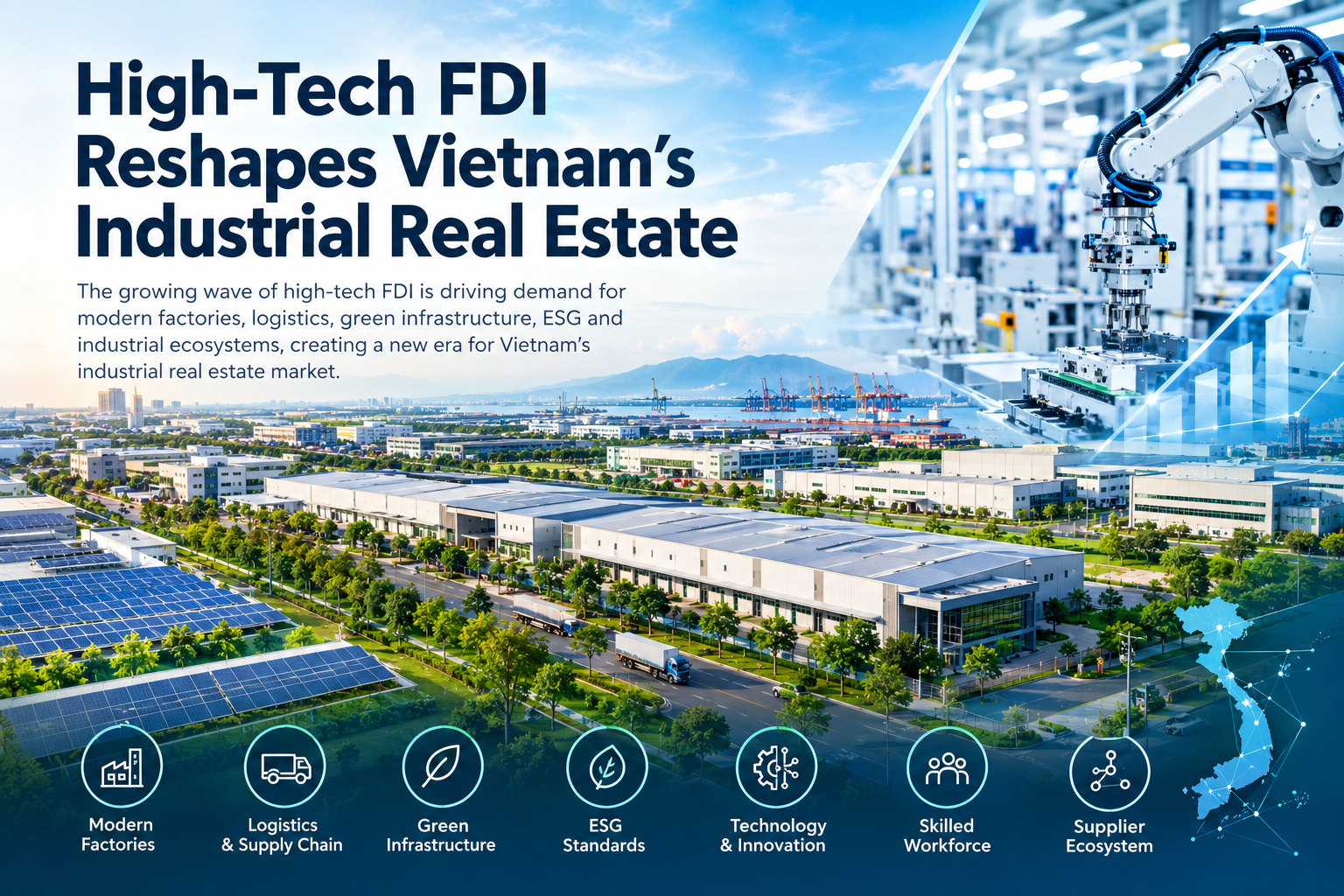
High-Tech FDI Is Creating New Demand for Industrial Real Estate
Vietnam continues to attract significant foreign investment, particularly in manufacturing and high-tech industries.
In the first eight months of 2026, realized FDI in Vietnam was estimated at USD 17.25 billion, representing an increase of approximately 12% year on year and the highest level recorded for the first eight months of a year over the past five years.
The manufacturing and processing sector remained the largest destination for realized FDI, reaching approximately USD 14.24 billion, accounting for 82.6% of total realized FDI.
The structure of new investment is also changing. High-value sectors such as electronics, computers, optical products, semiconductors, medical devices and advanced manufacturing are becoming increasingly important.
Among new manufacturing FDI projects, the northern region attracted approximately USD 8.63 billion, equivalent to around 80.5% of newly registered manufacturing FDI.
Meanwhile, investment in the production of computers, electronic products and optical products exceeded USD 7.03 billion, accounting for nearly 66% of total FDI.
These figures demonstrate that Vietnam’s industrial real estate market is no longer simply competing to provide industrial land. It is increasingly required to provide the infrastructure and operating environment needed by high-tech manufacturers.
Industrial Real Estate Requirements Are Changing
In the past, foreign investors often considered several basic factors when selecting industrial locations, including:
- Industrial land availability
- Competitive rental costs
- Labor costs
- Geographic location
- Proximity to major markets
- Access to transportation infrastructure
These factors remain important. However, they are no longer sufficient for high-tech investment projects.
According to Nguyen Phuoc Thuan, Director of Industrial & Office Leasing at Cushman & Wakefield Vietnam, international investors are increasingly paying attention to transparency, policy stability and the ability of government agencies to coordinate and support projects.
These factors can directly affect project implementation schedules, operational efficiency and long-term capital allocation.
As a result, industrial property developers must increasingly provide a comprehensive investment environment rather than simply offering industrial land.
From Industrial Land to a Complete Production Ecosystem
The most important transformation in Vietnam’s industrial real estate market is the shift from a land-based development model to an ecosystem-based model.
For high-tech manufacturers, an industrial park needs to provide more than a large land bank.
Investors increasingly require:
- High-quality industrial infrastructure
- Stable electricity and water supplies
- Modern wastewater treatment systems
- High-speed telecommunications
- Reliable logistics services
- Ready-built factories and warehouses
- Skilled labor
- Convenient access to ports and airports
- Supporting suppliers
- Component and spare-parts networks
- ESG-compliant infrastructure
- Stable administrative and regulatory support
This means that the industrial park itself is becoming an important component of the investor’s production strategy.
A location with a strong supplier network and efficient logistics infrastructure can reduce production costs and shorten supply-chain lead times.
Northern Vietnam Continues to Attract High-Tech Manufacturing
Northern Vietnam has emerged as an important manufacturing hub for electronics, computers and other high-tech industries.
By the second quarter of 2026, cumulative industrial land supply in the northern market had exceeded 25,200 hectares, representing an increase of approximately 15.7% year on year.
During the first half of 2026, more than 1,200 hectares of new industrial land entered the market through six industrial parks launched in areas including Hai Phong, Bac Ninh and Ninh Binh.
The ready-built factory market has also expanded rapidly.
The total supply of ready-built factories in Northern Vietnam reached approximately 5.8 million square meters, increasing by around 16.9%.
The expansion reflects strong expectations for continued manufacturing investment, particularly from electronics and high-tech companies.
Ready-Built Factories Become Increasingly Important
The development of ready-built factories (RBF) is one of the most important trends in Vietnam’s industrial real estate market.
For international manufacturers, ready-built factories can significantly shorten the time required to begin operations.
Instead of spending several years acquiring land, completing construction and preparing infrastructure, companies can lease an existing facility and focus their resources on production equipment, technology and workforce development.
This model is particularly attractive for:
- Electronics manufacturers
- Semiconductor-related companies
- Medical device manufacturers
- Precision engineering companies
- Technology companies
- Supporting industries
- Research and development facilities
As high-tech FDI continues to grow, demand for high-quality ready-built factories is expected to become increasingly sophisticated.
Multi-Storey Factories and Warehouses Offer a New Solution
Another emerging trend is the development of multi-storey factories and warehouses.
In major industrial markets where land availability is becoming increasingly constrained, vertical development can help maximize the use of industrial land.
Multi-storey factories are particularly suitable for industries such as:
- Electronics
- Semiconductors
- Medical devices
- Precision manufacturing
- Research and development
- Technology-related production
Meanwhile, multi-storey warehouses can serve:
- Logistics companies
- E-commerce businesses
- Distribution centers
- Cold-chain operators
- Urban logistics networks
According to Nguyen Phuoc Thuan, multi-storey industrial properties can become an important long-term solution to land constraints while simultaneously improving the quality and efficiency of industrial real estate supply.
Southern Vietnam Faces a Different Supply Situation
The industrial real estate market in Southern Vietnam is also undergoing major changes.
During the second quarter of 2026, there were no major new industrial land projects entering the market in the southern region, as Ho Chi Minh City, Dong Nai and Tay Ninh were completing planning and investment procedures following administrative boundary changes.
However, the ready-built warehouse market continued to expand.
Tay Ninh recorded approximately 56,000 square meters of additional ready-built warehouse supply, bringing total supply to around 6.85 million square meters.
This demonstrates the increasing importance of flexible industrial properties, particularly warehouses and ready-built facilities, in meeting the needs of manufacturers and logistics companies.
ESG Is Becoming an Important Requirement for High-Tech FDI
Environmental, social and governance (ESG) standards are increasingly becoming part of investment decision-making.
However, for high-tech manufacturers, ESG is only one element of a much broader requirement.
According to Truong Thi Chi Binh, Vice Chairwoman and Secretary General of the Vietnam Association for Supporting Industries (VASI), the next generation of FDI investors is looking not only at ESG standards but also at the stability and quality of the entire production ecosystem.
This includes:
- Industrial infrastructure
- Logistics systems
- Supporting industries
- Local suppliers
- Component manufacturers
- Spare-parts suppliers
- Skilled labor
- Stable utilities
- Reliable production services
Therefore, ESG-compliant industrial parks will need to combine environmental performance with operational efficiency.
Logistics Infrastructure Is Becoming a Competitive Advantage
For high-tech manufacturing, logistics can directly influence production efficiency.
Electronics, semiconductor and medical-device manufacturers often rely on complex international supply chains. Components may be imported from several countries, assembled in Vietnam and then exported to global markets.
Therefore, proximity to:
- International airports
- Deep-water seaports
- Major highways
- Inland container depots
- Logistics centers
- Regional consumer markets
can become a significant factor in site selection.
Industrial parks that provide efficient connections between factories, warehouses, ports and airports can help investors reduce transportation time and improve supply-chain reliability.
The Supplier Ecosystem Is Critical to High-Tech Manufacturing
One of the most important changes in the FDI landscape is the increasing importance of local supplier networks.
High-tech manufacturers do not operate independently. They require a large ecosystem of suppliers for:
- Components
- Materials
- Packaging
- Machinery
- Maintenance
- Spare parts
- Logistics
- Technical services
If Vietnamese companies cannot meet the quality, technology, delivery and compliance requirements of international manufacturers, foreign investors may choose to bring their existing overseas suppliers into Vietnam.
Once these foreign supplier networks become established, it may become more difficult for domestic companies to participate in the supply chain.
Therefore, developing a strong local supplier ecosystem is not only beneficial to industrial parks but can also create significant opportunities for Vietnamese supporting-industry companies.
Industrial Parks Must Become More Than Industrial Land
The competitive landscape of Vietnam’s industrial real estate market is changing.
Land availability, location and rental costs remain fundamental factors. However, they are increasingly becoming only the starting point of the investment decision.
The next generation of industrial parks will need to compete based on the quality of the overall ecosystem.
This includes:
1. Modern Infrastructure
Industrial parks need reliable electricity, water, wastewater treatment, telecommunications and internal transportation infrastructure.
2. High-Quality Industrial Properties
Ready-built factories, warehouses and specialized facilities can help investors accelerate market entry.
3. Efficient Logistics
Strong connections to ports, airports, highways and logistics hubs can improve supply-chain efficiency.
4. ESG and Green Development
Energy efficiency, renewable energy, water management, waste treatment and environmental standards are becoming increasingly important.
5. Skilled Workforce
High-tech manufacturing requires workers with increasingly specialized technical skills.
6. Supporting Industries
A strong network of domestic suppliers can make an industrial park more attractive to international manufacturers.
7. Stable Policy Environment
Transparency, administrative efficiency and government support can influence the timing and efficiency of investment projects.
New Opportunities for Vietnam’s Industrial Real Estate Market
The transformation of FDI toward high-tech manufacturing is creating new opportunities for industrial property developers.
Rather than developing large industrial land banks alone, developers can create specialized industrial ecosystems designed around specific industries.
For example, an industrial park focused on electronics could provide:
- High-standard ready-built factories
- Clean production infrastructure
- Stable power supply
- Electronics component suppliers
- Logistics services
- Skilled technical labor
- Testing and quality-control facilities
- R&D space
Similarly, industrial parks targeting logistics and e-commerce could focus on:
- Multi-storey warehouses
- Automated storage systems
- Cold-chain facilities
- Distribution centers
- High-speed highway connections
- Digital logistics infrastructure
This industry-specific approach could become an increasingly important development strategy.
Vietnam’s Industrial Real Estate Market Is Entering a New Competitive Era
The rise of high-tech FDI is fundamentally changing the requirements for industrial real estate in Vietnam.
Competition is gradually moving away from simply offering:
“Land + Location + Low Cost”
toward a more comprehensive model:
“Infrastructure + Factory + Logistics + ESG + Suppliers + Workforce + Industrial Ecosystem.”
For international investors, the quality of the surrounding ecosystem can directly influence production efficiency, operating costs and long-term investment strategies.
For industrial park developers, this creates pressure to upgrade infrastructure, diversify industrial products and develop deeper connections with manufacturers, logistics providers and supporting industries.
For Vietnamese companies, the expansion of high-tech FDI also represents an opportunity to participate more deeply in global supply chains—provided that domestic suppliers can meet international standards for technology, quality, cost, delivery and sustainability.
Conclusion: High-Tech FDI Is Redefining Industrial Real Estate in Vietnam
Vietnam’s industrial real estate market is entering a new stage of development.
The strong growth of high-tech FDI, particularly in electronics, computers, optical products, advanced manufacturing and supporting industries, is creating increasingly sophisticated requirements for industrial property.
Industrial parks will no longer compete only on land availability and rental prices.
The future competitive advantages will increasingly come from:
Modern infrastructure, high-quality factories, efficient logistics, ESG standards, skilled labor, supplier networks and a complete production ecosystem.
For industrial real estate developers and investors, this transformation creates both challenges and opportunities.
The industrial park of the future will not simply be a place where factories are located.
It will become an integrated production ecosystem designed to support the entire value chain of high-tech manufacturing in Vietnam.
References:
Free access to exclusive information on warehouse, factory, and land rentals in Dong Nai, Binh Duong, Long An, Ho Chi Minh City, and more.
KHU CÔNG NGHIỆP 247 is a company operating in the field of buying, selling, and leasing factories and real estate.. We are proud to be a leading provider of real estate services in Vietnam. We have a team of highly qualified and experienced real estate consultants who always place trust and credibility at the core of everything we do.
Phone: 0901 490 348
Email: datkhucongnghiep247@gmail.com
Website: datkhucongnghiep247.com.vn