

Vietnam’s industrial real estate market remains one of the country’s most attractive investment sectors, supported by strong foreign direct investment (FDI) inflows and continued manufacturing expansion. However, second-quarter financial statements released in 2026 revealed a sharply divided picture among industrial park developers. While some companies maintained strong earnings thanks to industrial land leasing and infrastructure services, many major developers experienced significant declines in profitability.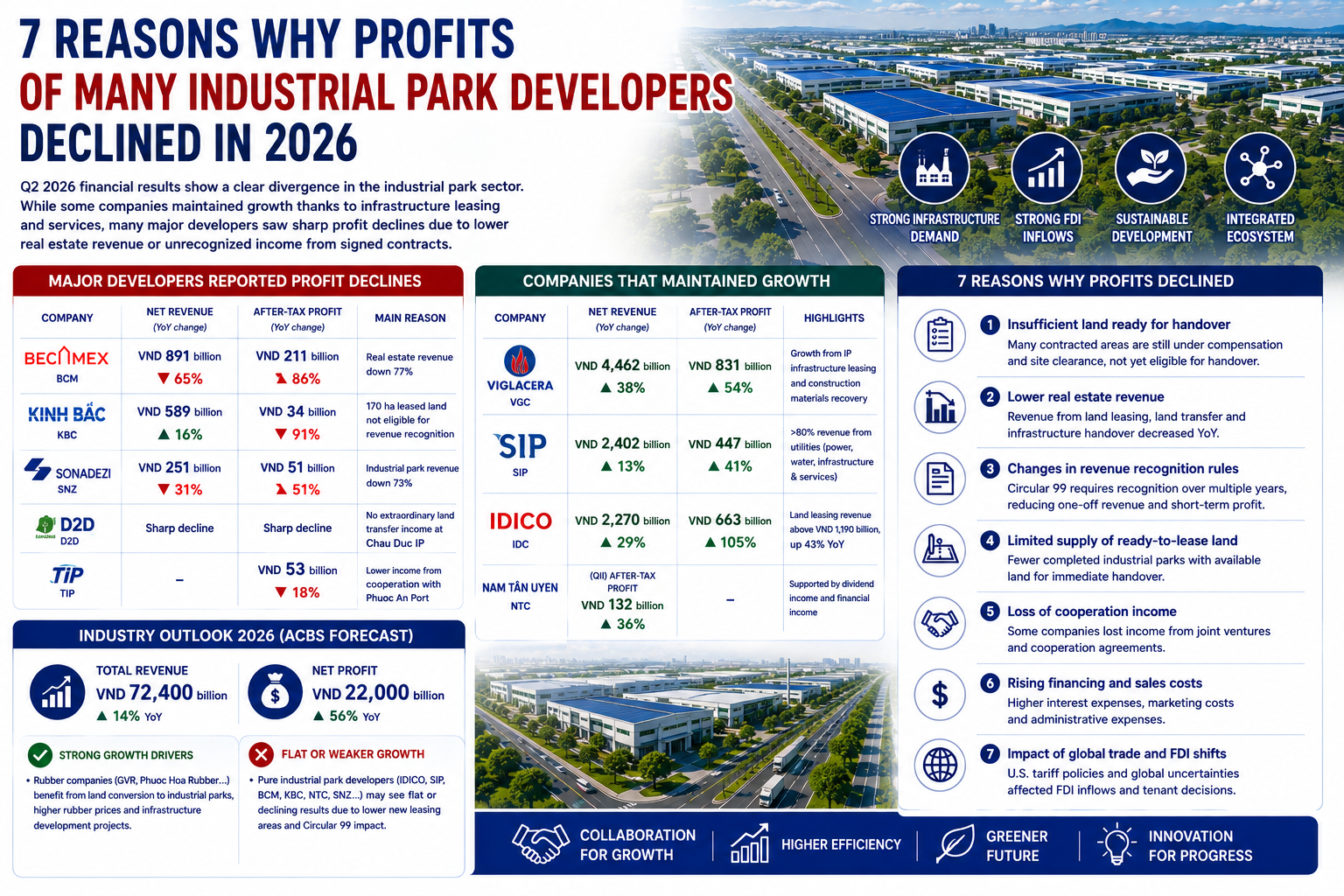
This divergence reflects the changing dynamics of Vietnam’s industrial property market, where project delivery schedules, available industrial land, accounting regulations, and diversified revenue streams have become increasingly important determinants of financial performance.
Major Industrial Park Developers Report Sharp Profit Declines
Several leading industrial park companies posted disappointing earnings during the second quarter of 2026.
Becamex IDC Recorded the Largest Decline
Becamex IDC (HOSE: BCM) reported:
- Net revenue: nearly VND 891 billion, down 65% year-on-year.
- After-tax profit: approximately VND 211 billion, down 86%.
The primary reason was a sharp decline in the company’s real estate business, where revenue fell 77% to approximately VND 524 billion.
For the first six months of 2026:
- Revenue reached nearly VND 1.662 trillion.
- After-tax profit totaled approximately VND 320 billion.
Both figures declined by more than 65% compared with the same period last year.
Kinh Bac (KBC) Saw Profit Drop More Than 91%
Kinh Bac City Development Holding Corporation (HOSE: KBC) continued to report revenue growth but experienced a dramatic decline in earnings.
Second-quarter results included:
- Net revenue: approximately VND 589 billion, up 16%.
- After-tax profit: only VND 34 billion, down 91%.
According to the company, contracts for leasing more than 170 hectares of industrial land have already been signed but cannot yet be recognized because land clearance and compensation work has not been completed.
Revenue from these contracts is expected to be recognized later this year.
Sonadezi Faced Weak Industrial Park Revenue
Sonadezi Corporation (UPCoM: SNZ) also reported weaker financial performance.
During Q2:
- Revenue declined approximately 31%.
- After-tax profit fell 51%.
Industrial park revenue decreased by 73%, falling to approximately VND 251 billion.
During the first half of 2026:
- Revenue totaled VND 2.754 trillion.
- After-tax profit reached approximately VND 732 billion.
D2D Lost Its Extraordinary Revenue Source
Urban Industrial Development No.2 Corporation (HOSE: D2D) also reported a sharp decline because it no longer benefited from the extraordinary land transfer revenue generated at Chau Duc Industrial Park during the same period last year.
As a result:
- Revenue fell sharply.
- Profit declined significantly.
TIP Experienced Lower Earnings
Tin Nghia Industrial Park Development Corporation (HOSE: TIP) reported:
- Q2 profit of approximately VND 53 billion.
- Down 18% year-on-year.
The decline mainly resulted from reduced income generated through its cooperation agreement related to Phuoc An Port.
Why Did Profits Decline?
Several major factors contributed to weaker profitability across the industrial park sector.
1. Insufficient Land Ready for Handover
Many industrial land lease agreements have already been signed.
However, projects are still undergoing:
- Land clearance.
- Compensation.
- Legal procedures.
Without completed handovers, developers cannot recognize revenue.
This has become one of the biggest challenges for companies such as Kinh Bac.
2. Falling Industrial Real Estate Revenue
Revenue from:
- Industrial land leasing.
- Land transfers.
- Infrastructure handovers.
declined considerably compared with previous periods.
Since these activities generate the majority of earnings for most developers, profitability fell accordingly.
3. New Revenue Recognition Regulations
Vietnam’s Circular No. 99 introduced changes requiring some developers to:
- Stop recognizing industrial land lease revenue immediately.
- Allocate revenue over multiple years instead.
This accounting adjustment affects companies including:
- Nam Tan Uyen (NTC).
- Sonadezi Chau Duc (SZC).
Although cash flow remains healthy, reported earnings are lower in the short term.
4. Limited Supply of Ready-to-Lease Industrial Land
Compared with previous years, fewer industrial parks now have:
- Completed infrastructure.
- Cleared land.
- Immediate delivery capability.
Consequently, revenue recognition has slowed.
Which Companies Continued Growing?
Despite the industry’s mixed performance, several developers maintained strong growth.
Viglacera Delivered Outstanding Results
Viglacera Corporation (HOSE: VGC) reported:
- Revenue: more than VND 4.462 trillion, up 38%.
- After-tax profit: over VND 831 billion, up 54%.
Growth was primarily driven by:
- Industrial park infrastructure leasing.
- Recovery in construction materials.
SIP Benefited from Diversified Services
Saigon VRG Investment Corporation (HOSE: SIP) continued delivering impressive performance.
Second-quarter results included:
- Revenue of more than VND 2.402 trillion, up 13%.
- After-tax profit exceeding VND 447 billion, up 41%.
Unlike many developers that rely heavily on land leasing, SIP generates stable income from:
- Electricity supply.
- Water supply.
- Industrial infrastructure.
- Utility services.
These businesses contribute more than 80% of total revenue, creating stable long-term cash flow.
IDICO Maintained Strong Growth
IDICO Corporation (HNX: IDC) remained one of the sector’s brightest performers.
Second-quarter results:
- Revenue reached VND 2.27 trillion, up 29%.
- After-tax profit totaled VND 663 billion, recording strong year-on-year growth.
For the first six months:
- Revenue approached VND 3.8 trillion.
- After-tax profit exceeded VND 1.001 trillion.
Revenue from industrial land leasing surpassed VND 1.19 trillion, increasing approximately 43%.
Nam Tan Uyen Benefited from Financial Income
Nam Tan Uyen Industrial Park Corporation (UPCoM: NTC) reported:
- Q2 after-tax profit of approximately VND 132 billion, up 36%.
Growth mainly came from:
- Dividend income.
- Financial investment returns.
However:
- Six-month revenue still declined approximately 41%, indicating that core operations remain under pressure.
Industry Outlook Remains Highly Differentiated
According to a report by ACBS Securities, Vietnam’s industrial real estate sector is expected to generate:
- Total revenue of approximately VND 72.4 trillion in 2026, up 14%.
- Net profit approaching VND 22 trillion, increasing 56% year-on-year.
Growth will mainly come from companies converting rubber plantations into industrial parks, including:
- Vietnam Rubber Group (GVR).
- Phuoc Hoa Rubber.
These companies are expected to benefit from:
- Compensation for land conversion.
- Higher rubber prices.
- Infrastructure development projects.
Meanwhile, traditional industrial park developers such as:
- Becamex IDC.
- Kinh Bac.
- Sonadezi.
- Nam Tan Uyen.
- IDICO.
- SIP.
may continue experiencing mixed financial results depending on:
- Land handover schedules.
- Revenue recognition timing.
- FDI inflows.
- Industrial land demand.
Market Outlook
Although many industrial park developers experienced weaker short-term earnings, Vietnam’s industrial real estate sector continues to offer strong long-term growth potential. Global supply chain diversification, rising foreign direct investment, expanding high-tech manufacturing, and major infrastructure projects continue creating favorable conditions for industrial park development. Companies with clean land banks, efficient project execution, diversified service income, and integrated industrial ecosystems are expected to outperform the market over the coming years.
Conclusion
The second-quarter 2026 earnings season clearly illustrates the growing divergence among Vietnam’s industrial park developers. While major companies such as Becamex IDC, Kinh Bac, and Sonadezi faced pressure from delayed revenue recognition and limited ready-to-lease land, developers including Viglacera, SIP, and IDICO continued achieving strong growth through diversified revenue sources and efficient industrial park operations. Going forward, competitive advantage will depend not only on land bank size but also on project execution, financial management, service diversification, and the ability to deliver industrial land quickly to investors.
References:
Free access to exclusive information on warehouse, factory, and land rentals in Dong Nai, Binh Duong, Long An, Ho Chi Minh City, and more.
KHU CÔNG NGHIỆP 247 is a company operating in the field of buying, selling, and leasing factories and real estate.. We are proud to be a leading provider of real estate services in Vietnam. We have a team of highly qualified and experienced real estate consultants who always place trust and credibility at the core of everything we do.
Phone: 0901 490 348
Email: datkhucongnghiep247@gmail.com
Website: datkhucongnghiep247.com.vn