


Strong Demand Positions Vietnam as a Strategic Logistics Center
Vietnam is rapidly emerging as one of the most dynamic logistics markets in the Asia-Pacific region. Driven by global supply chain diversification, export-oriented manufacturing growth, and booming e-commerce activity, the country is becoming an increasingly important link in the global supply chain.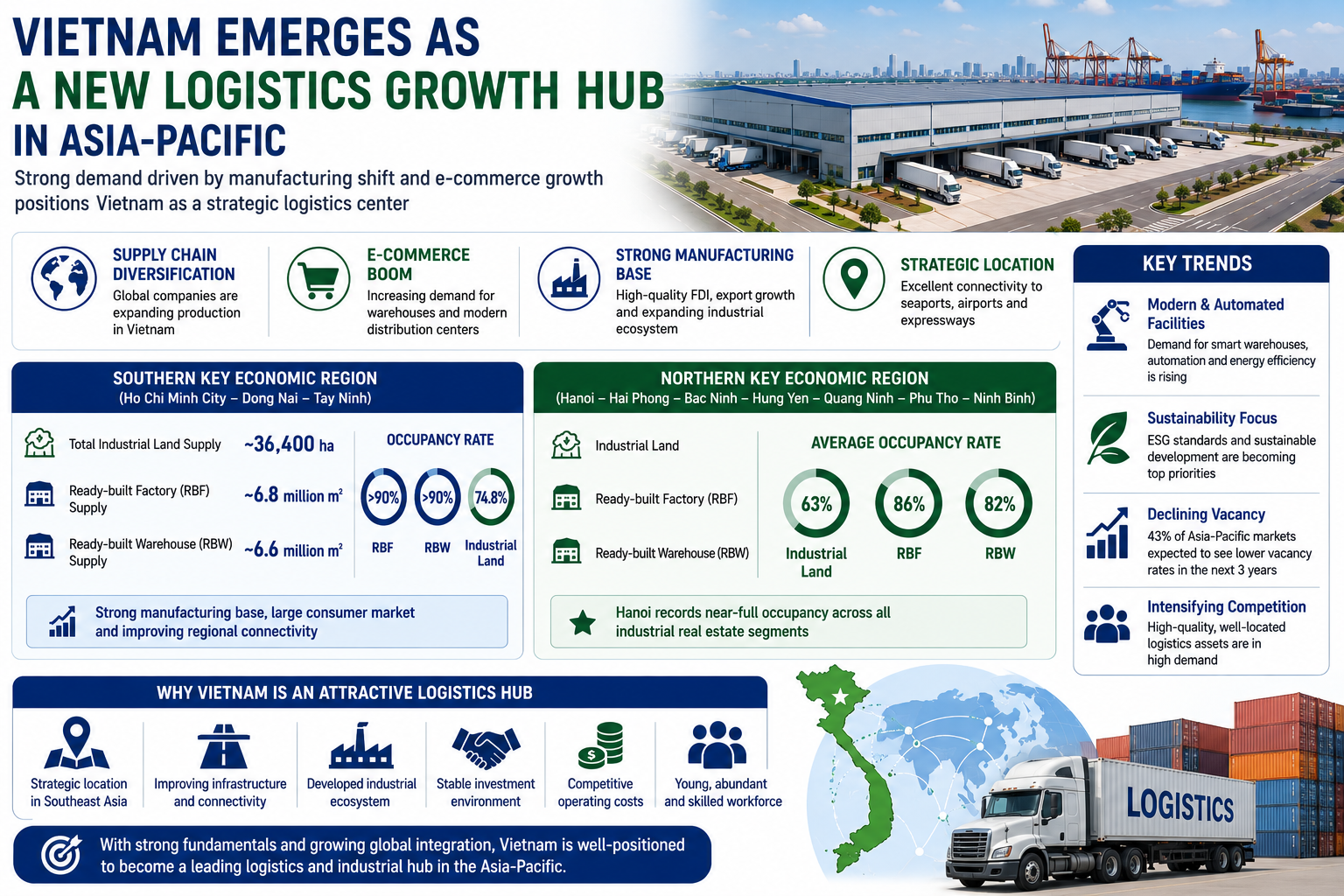
According to Cushman & Wakefield’s Waypoint 2026 report, rising demand for logistics and industrial space is steadily reducing vacancy rates across Vietnam and Southeast Asia, reinforcing the region’s role as a critical manufacturing and distribution hub for international businesses.
As companies continue expanding production networks and diversifying supply chains, Vietnam is benefiting from growing demand for industrial parks, logistics facilities, warehouses, and modern distribution centers.
Southeast Asia Benefits from Global Supply Chain Shifts
The Asia-Pacific logistics market continues to be driven primarily by manufacturing and e-commerce activities. Southeast Asia, in particular, is gaining momentum as multinational corporations seek to regionalize supply chains and reduce dependence on single-country production bases.
Countries such as:
- Vietnam
- Indonesia
- Thailand
are experiencing robust leasing activity, strengthening their positions as strategic manufacturing and logistics hubs.
Vietnam’s growth is supported by:
- Export-oriented foreign investment.
- Expanding manufacturing capacity.
- Rising domestic consumption.
- Strategic geographic location.
As a result, demand for industrial and logistics facilities continues to increase, especially in locations offering strong connectivity to ports, airports, expressways, and major manufacturing clusters.
Southern Vietnam Remains the Largest Industrial and Logistics Market
The Southern Key Economic Region, including Ho Chi Minh City, Dong Nai, and Tay Ninh, continues to benefit from its established manufacturing ecosystem, large consumer market, and improving infrastructure connectivity.
According to Cushman & Wakefield’s HCMC MarketBeat Q1 2026 report:
- Total industrial land supply reached approximately 36,400 hectares.
- Ready-built factory (RBF) supply totaled around 6.8 million square meters.
- Ready-built warehouse (RBW) supply reached approximately 6.6 million square meters.
Occupancy levels remain exceptionally strong:
- Over 90% for ready-built factories.
- Over 90% for ready-built warehouses.
- 74.8% for industrial land.
These figures demonstrate the sustained demand for industrial and logistics real estate in Southern Vietnam.
Northern Vietnam Attracts High-Tech Manufacturing Investment
The Northern Key Economic Region, including Hanoi, Hai Phong, Bac Ninh, Hung Yen, Quang Ninh, Phu Tho, and Ninh Binh, is becoming an increasingly attractive destination for electronics manufacturing, high-value production, and cross-border trade.
Average occupancy rates across the region currently stand at:
- 63% for industrial land.
- 86% for ready-built factories.
- 82% for ready-built warehouses.
Hanoi, in particular, has achieved near-full occupancy across all industrial real estate segments, while surrounding provinces continue to experience strong leasing activity.
The region’s growing prominence reflects increasing investment from technology companies, electronics manufacturers, and export-oriented industries.
Vietnam Strengthens Its Position in the Global Supply Chain
According to Nguyen Phuoc Thuan, Head of Leasing at Cushman & Wakefield Vietnam, the country has witnessed a clear influx of electronics manufacturers and high-tech companies in recent years.
Both existing investors and new market entrants are expanding operations in Vietnam, reinforcing the country’s role as a strategic manufacturing base within global supply chains.
Investor priorities are also evolving. While location remains important, companies are increasingly focusing on:
- Infrastructure quality.
- Developer capabilities.
- Operational standards.
- Logistics efficiency.
- Long-term expansion potential.
These factors are becoming key determinants in site selection decisions.
Modern Logistics Facilities Gain Momentum
Another significant trend is the increasing demand for modern logistics facilities designed to support automation, energy efficiency, and operational resilience.
Businesses are increasingly seeking:
- Automated warehouses.
- Smart distribution centers.
- Energy-efficient facilities.
- ESG-compliant logistics assets.
- Cross-border trade infrastructure.
Warehousing facilities serving high-value goods and international trade are undergoing substantial upgrades, with development standards increasingly aligned with global benchmarks.
This trend is creating new opportunities for developers and investors capable of delivering next-generation logistics assets.
Competition Intensifies for High-Quality Logistics Assets
The Waypoint 2026 report forecasts that approximately 43% of Asia-Pacific logistics markets will experience declining vacancy rates over the next three years as demand continues to strengthen and new supply remains relatively controlled.
Consequently, competition for well-located, high-quality logistics facilities is expected to intensify, particularly in areas with strong access to:
- Seaports.
- International airports.
- Expressways.
- Manufacturing hubs.
Modern logistics assets with advanced operational capabilities are expected to command growing interest from both occupiers and investors.
Sustainability and Technology Reshape Logistics Real Estate
Tenant requirements are also changing rapidly.
Companies increasingly prioritize facilities that offer:
- Automation readiness.
- Energy efficiency.
- Sustainability features.
- Supply chain resilience.
- Long-term operational performance.
As a result, newer and more technologically advanced logistics properties are becoming the preferred choice for global manufacturers and logistics operators.
The growing emphasis on Environmental, Social, and Governance (ESG) standards is further accelerating the transformation of Vietnam’s logistics real estate sector.
Bright Outlook for Vietnam’s Logistics Industry
According to Dennis Yeo, Head of Investor Services and Logistics & Industrial, Asia Pacific at Cushman & Wakefield, Southeast Asia is entering a new growth cycle as supply chain diversification becomes a structural rather than cyclical trend.
As demand continues to expand, competition for premium logistics assets is expected to increase significantly, especially in strategic locations with superior connectivity.
This environment creates substantial opportunities for investors, developers, and logistics operators capable of delivering future-ready facilities that meet evolving operational and technological requirements.
Conclusion
Vietnam is rapidly establishing itself as a key logistics growth center in the Asia-Pacific region. Supported by strong manufacturing activity, expanding e-commerce, rising foreign investment, and ongoing infrastructure development, the country is becoming an increasingly strategic destination for industrial and logistics operations.
With high occupancy rates, growing demand for modern logistics facilities, and strong integration into global supply chains, Vietnam is well-positioned to become one of the region’s leading logistics and industrial hubs in the years ahead.
References:
Free access to exclusive information on warehouse, factory, and land rentals in Dong Nai, Binh Duong, Long An, Ho Chi Minh City, and more.
KHU CÔNG NGHIỆP 247 is a company operating in the field of buying, selling, and leasing factories and real estate.. We are proud to be a leading provider of real estate services in Vietnam. We have a team of highly qualified and experienced real estate consultants who always place trust and credibility at the core of everything we do.
Phone: 0901 490 348
Email: datkhucongnghiep247@gmail.com
Website: datkhucongnghiep247.com.vn