

Vietnam’s Industrial Real Estate Enters a New Growth Cycle Driven by FDI and Global Supply Chain Shifts
Vietnam’s industrial real estate market has emerged as one of the brightest sectors in the country’s property industry, benefiting from strong foreign direct investment (FDI), global supply chain diversification, and expanding manufacturing activities by multinational corporations. However, industry experts warn that this opportunity will favor only those provinces and developers capable of rapid transformation. To attract the next generation of FDI, Vietnam must accelerate green industrial development, institutional reform, and infrastructure modernization.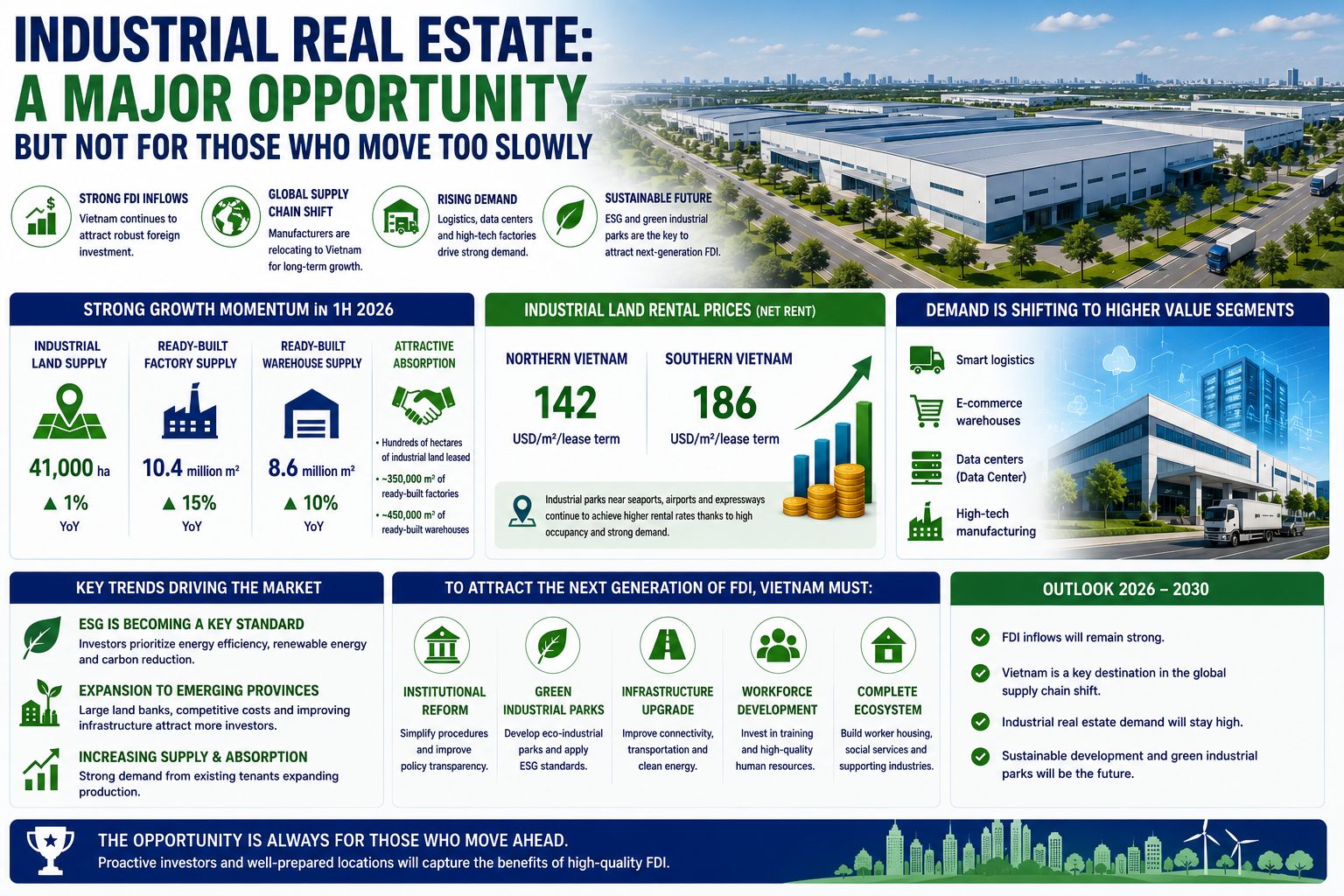
Industrial Real Estate Faces Its Biggest Growth Opportunity in Years
As the global economy gradually recovers, Vietnam continues to strengthen its position as one of Asia’s leading manufacturing and logistics hubs.
According to John Campbell, Director of Industrial Services at Savills Vietnam, investor demand is no longer limited to traditional manufacturing facilities. Instead, it is rapidly expanding into high-value sectors such as:
- Smart logistics
- Technology-enabled e-commerce warehouses
- Large-scale data centers
- High-tech manufacturing facilities
- Modern logistics infrastructure
John Campbell commented:
“Occupancy and absorption rates across key industrial markets in both northern and southern Vietnam remain exceptionally strong, reinforcing Vietnam’s strategic role within the global manufacturing network.”
These indicators demonstrate that Vietnam’s industrial real estate market has entered a new growth cycle supported by stronger long-term fundamentals than ever before.
Industrial Supply Continues to Expand While Market Absorption Remains Strong
According to JLL, industrial real estate supply continued to grow steadily during the first half of 2026.
Key market statistics include:
- Nearly 41,000 hectares of industrial land, up 1% year-over-year.
- Approximately 10.4 million square meters of ready-built factories, increasing 15%.
- Around 8.6 million square meters of ready-built warehouses, up 10%.
Demand also remained healthy, with transactions totaling:
- Hundreds of hectares of industrial land.
- Approximately 350,000 square meters of ready-built factories leased.
- Approximately 450,000 square meters of ready-built warehouses leased.
Most demand came from existing foreign manufacturers expanding production capacity to meet growing export demand.
Investors Are Expanding into Emerging Industrial Markets
Previously, manufacturers concentrated primarily in:
- Bắc Ninh
- Hải Phòng
- Bình Dương
- Đồng Nai
Today, however, an increasing number of investors are exploring emerging provinces.
The main advantages include:
- Larger industrial land reserves
- More competitive rental costs
- Improving transportation infrastructure
- Better connectivity to seaports and expressways
This trend is not only expanding Vietnam’s industrial footprint but also creating significant growth opportunities for secondary industrial markets.
Industrial Real Estate Serves as a Foundation for National Industrial Growth
According to Dr. Nguyễn Đức Hiển, Deputy Head of the Central Policy and Strategy Commission, industrial real estate has evolved beyond simply providing land for factories—it has become a key driver of Vietnam’s industrial development.
He believes future growth lies not only in expanding industrial land but also in creating new development ecosystems centered on:
- Digital transformation
- Green transformation
- Free Trade Zones (FTZs)
- High-tech industrial parks
- Eco-industrial parks
These initiatives are expected to strengthen Vietnam’s competitiveness for decades to come.
Institutional Reform Is Essential to Attract the Next Generation of FDI
According to Will Trần, Head of Industrial and Office Leasing at JLL Vietnam, the country’s industrial property market still possesses tremendous growth potential.
JLL estimates that if only a small percentage of manufacturers across the Asia-Pacific region relocate or expand operations into Vietnam, existing industrial supply could be fully absorbed.
However, traditional competitive advantages such as:
- Low production costs
- Abundant industrial land
- Strategic geographic location
are no longer sufficient.
Today’s global investors increasingly evaluate:
- Infrastructure quality
- Transparent investment policies
- Efficient administrative procedures
- Skilled labor availability
- Sustainable development capabilities
This makes institutional reform a critical priority for maintaining Vietnam’s competitive edge.
Industrial Land Rental Prices Continue Rising
Strong demand has continued pushing industrial land rental rates upward throughout 2026.
According to JLL:
Northern Vietnam
- US$142 per square meter per lease term
Southern Vietnam
- US$186 per square meter per lease term
Industrial parks located near:
- International seaports
- Airports
- Expressways
- Major logistics hubs
continue to command premium rental rates due to strong occupancy levels.
Meanwhile, emerging industrial provinces with larger land inventories provide tenants with more alternatives and help ease short-term rental pressure.
ESG Has Become a Key Investment Criterion
One of the market’s most significant trends is the growing importance of Environmental, Social and Governance (ESG) standards.
According to Will Trần, companies operating in:
- Electronics
- High technology
- Logistics
- Data centers
are increasingly prioritizing industrial projects that feature:
- Energy-efficient operations
- Renewable energy integration
- Carbon emission reduction
- Green building certifications
This trend is expected to accelerate the development of:
- Green industrial parks
- Modern manufacturing facilities
- Next-generation logistics assets
over the coming years.
Green Industrial Parks Will Define Future Competitiveness
Savills believes that Vietnam must accelerate the transition toward greener industrial parks to attract high-quality foreign investment.
Future industrial developments should incorporate:
- Comprehensive ESG standards
- Artificial Intelligence (AI)
- Warehouse automation
- Clean energy infrastructure
- Modern transportation networks
These factors will be essential for attracting and retaining global technology manufacturers.
Building a Complete Industrial Ecosystem Is the Next Priority
According to Dr. Nguyễn Đức Hiển, Vietnam’s biggest bottleneck is no longer industrial land availability but institutional reform and strategic planning.
To strengthen competitiveness, Vietnam should shift its investment strategy from quantitative expansion toward qualitative development by:
- Developing eco-industrial parks.
- Promoting high-tech industrial zones.
- Creating specialized industrial clusters.
- Simplifying administrative procedures.
- Investing in workforce development.
- Expanding worker housing and social infrastructure.
- Strengthening supporting industries and business services.
A comprehensive industrial ecosystem will enable Vietnam not only to attract but also to retain leading multinational technology corporations amid intensifying global competition for FDI.
Outlook for Vietnam’s Industrial Real Estate Market Remains Highly Positive
Industry experts remain optimistic about Vietnam’s industrial real estate market through 2026–2030, supported by several long-term growth drivers:
- Continued growth in foreign direct investment.
- Ongoing global supply chain diversification.
- Accelerated infrastructure development.
- Expansion of green industrial parks.
- Rising demand for logistics facilities and data centers.
- Continued improvements in investment policies.
If Vietnam successfully accelerates institutional reform, infrastructure upgrades, and ESG implementation, the country is well-positioned to become one of Asia’s leading hubs for high-tech manufacturing and industrial investment.
Conclusion
Vietnam’s industrial real estate market is entering one of its strongest growth periods in recent years, driven by robust FDI inflows, global manufacturing relocation, and increasing demand for industrial facilities. However, competitive advantages based solely on low costs and abundant land are no longer sufficient. In the race to attract high-quality investment, green industrial parks, world-class infrastructure, transparent institutions, and a complete industrial ecosystem will determine Vietnam’s long-term success as a global manufacturing powerhouse.
References:
Free access to exclusive information on warehouse, factory, and land rentals in Dong Nai, Binh Duong, Long An, Ho Chi Minh City, and more.
KHU CÔNG NGHIỆP 247 is a company operating in the field of buying, selling, and leasing factories and real estate.. We are proud to be a leading provider of real estate services in Vietnam. We have a team of highly qualified and experienced real estate consultants who always place trust and credibility at the core of everything we do.
Phone: 0901 490 348
Email: datkhucongnghiep247@gmail.com
Website: datkhucongnghiep247.com.vn