


Industrial Land and Ready-Built Warehouses Lead Vietnam’s Industrial Real Estate Growth
Vietnam’s industrial real estate market continued to post encouraging results during the first half of 2026, with industrial land and ready-built warehouses emerging as the key growth drivers. Supported by stable foreign direct investment (FDI), expanding manufacturing activities, and rising logistics demand, Northern Vietnam recorded its highest industrial land absorption since the first quarter of 2024.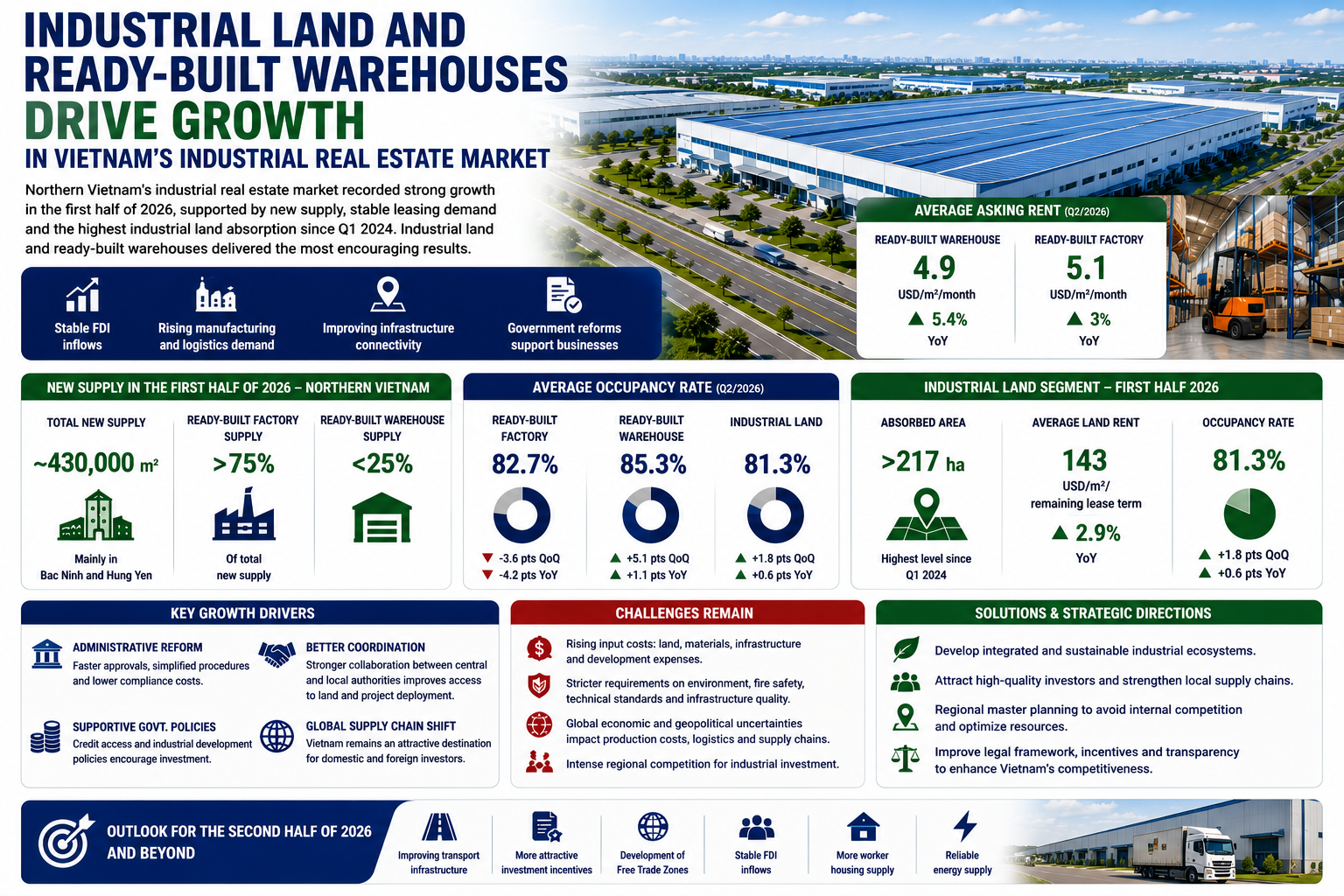
According to CBRE Vietnam, while the rapid increase in new supply put pressure on the ready-built factory segment, industrial land and ready-built warehouses continued to deliver strong performance in terms of both rental growth and market absorption.
Industrial Real Estate Supply Continues to Expand
During the first six months of 2026, Northern Vietnam welcomed several large-scale industrial real estate projects, primarily located in Bắc Ninh and Hưng Yên.
According to CBRE, total new supply reached approximately 430,000 square meters, with more than 75% consisting of ready-built factories.
The continuous addition of new projects has provided manufacturers with more leasing options while temporarily reducing occupancy rates in the ready-built factory segment.
As of the second quarter of 2026:
- Ready-built factory occupancy reached 82.7%.
- Down 3.6 percentage points quarter-over-quarter.
- Down 4.2 percentage points year-over-year.
This decline mainly reflects rapid supply expansion rather than weakening demand.
Ready-Built Warehouses Continue to Outperform
Unlike ready-built factories, ready-built warehouses continued to perform strongly.
New warehouse supply remained relatively moderate while leasing demand stayed healthy from:
- Logistics companies
- Manufacturing firms
- E-commerce businesses
As a result, the average warehouse occupancy rate in the second quarter of 2026 reached:
- 85.3%
- Up 5.1 percentage points quarter-over-quarter.
- Up 1.1 percentage points year-over-year.
The strong performance reflects increasing demand for logistics facilities and warehousing as Vietnam’s manufacturing and e-commerce sectors continue to expand.
Industrial Property Rental Rates Continue to Rise
Alongside strong leasing activity, industrial property rental rates continued their upward trend.
According to CBRE, average asking rents in Northern Vietnam’s primary industrial markets reached:
Ready-Built Warehouses
- US$4.9 per square meter per month
- Up 5.4% year-over-year.
Ready-Built Factories
- US$5.1 per square meter per month
- Up 3% year-over-year.
The continued increase in rental rates indicates that occupier demand remains strong enough to absorb new supply, particularly in well-located industrial projects with high-quality infrastructure.
Industrial Land Records Highest Absorption Since 2024
One of the most notable highlights of the market was the strong recovery in the industrial land segment.
During the first half of 2026:
- Total industrial land absorption exceeded 217 hectares.
- This marked the highest level since Q1 2024.
Meanwhile:
- Average industrial land rental rates reached US$143 per square meter per remaining lease term.
- Up 2.9% year-over-year.
Occupancy rates also improved to:
- 81.3%
- Up 1.8 percentage points quarter-over-quarter.
- Up 0.6 percentage points year-over-year.
These indicators demonstrate that Northern Vietnam’s industrial real estate market continues to attract both domestic and international manufacturers.
Administrative Reforms Create New Growth Momentum
According to Nguyễn Văn Nghĩa, Deputy General Director of Taseco Real Estate Investment JSC, Vietnam’s industrial real estate sector is benefiting from a series of government reforms aimed at improving the investment environment.
Recent improvements include:
- Faster project approval procedures.
- Simplified administrative processes.
- Greater decentralization to local governments.
- Improved access to industrial land.
These reforms have helped developers reduce project timelines, lower investment costs, and improve implementation efficiency.
Supportive credit policies and government initiatives promoting industrial development have also contributed to stronger domestic and foreign investment flows.
Industrial Real Estate Still Faces Significant Challenges
Despite strong growth prospects, the sector continues to face several challenges.
Industrial park developers are under increasing pressure from:
- Rising land acquisition costs.
- Higher construction material prices.
- Increasing infrastructure investment expenses.
- Stricter environmental and ESG requirements.
- More demanding fire safety and technical regulations.
- Global economic uncertainty and geopolitical risks.
These factors have increased project development costs and extended implementation timelines.
Building Complete Industrial Ecosystems Is the Key to Long-Term Success
According to Nguyễn Văn Nghĩa, industrial real estate development should go beyond simply constructing industrial infrastructure.
The priority should be creating integrated industrial ecosystems that include:
- High-quality manufacturing tenants.
- Strong domestic supply chains.
- Modern logistics connectivity.
- Specialized industrial clusters.
- Higher value-added industrial production.
When high-quality manufacturers are concentrated within a well-developed ecosystem, industrial parks become significantly more competitive and sustainable over the long term.
Vietnam Must Strengthen Regional Competitiveness
Vietnam is currently competing directly with neighboring countries such as:
- Thailand
- Malaysia
- Indonesia
To maintain its competitive advantage in attracting FDI, industry experts recommend:
- Coordinated regional planning.
- Avoiding unnecessary competition among provinces.
- Further improving investment incentives.
- Simplifying administrative procedures.
- Enhancing legal transparency.
- Strengthening government efficiency.
These measures will play a crucial role in improving Vietnam’s competitiveness within Southeast Asia.
Positive Outlook for the Second Half of 2026
According to Nguyễn Hoài An, representative of CBRE Vietnam, the outlook for Vietnam’s industrial real estate market remains highly positive throughout the second half of 2026 and beyond.
Key growth drivers include:
- Continued investment in transportation infrastructure.
- More attractive investment incentive policies.
- Development of Free Trade Zones (FTZs).
- Stable foreign direct investment inflows.
- Expansion of worker housing projects.
- Reliable energy supply for industrial production.
Together, these factors are expected to reinforce Vietnam’s position as one of Asia’s most attractive destinations for industrial investment.
Conclusion
The first half of 2026 confirmed that industrial land and ready-built warehouses have become the primary growth engines of Vietnam’s industrial real estate market. Although developers continue to face challenges related to rising development costs, ESG compliance, and regional competition, ongoing government reforms, improving infrastructure, and stable FDI inflows provide strong foundations for sustained market growth over the coming years.
References:
Free access to exclusive information on warehouse, factory, and land rentals in Dong Nai, Binh Duong, Long An, Ho Chi Minh City, and more.
KHU CÔNG NGHIỆP 247 is a company operating in the field of buying, selling, and leasing factories and real estate.. We are proud to be a leading provider of real estate services in Vietnam. We have a team of highly qualified and experienced real estate consultants who always place trust and credibility at the core of everything we do.
Phone: 0901 490 348
Email: datkhucongnghiep247@gmail.com
Website: datkhucongnghiep247.com.vn