

As ESG standards, sustainable development, and carbon emission reduction become increasingly important across global supply chains, Eco-Industrial Parks (EIPs) are emerging as the future of Vietnam’s industrial development. Beyond optimizing resource utilization, reducing production costs, and promoting the circular economy, eco-industrial parks are becoming a significant competitive advantage in attracting high-quality foreign direct investment (FDI).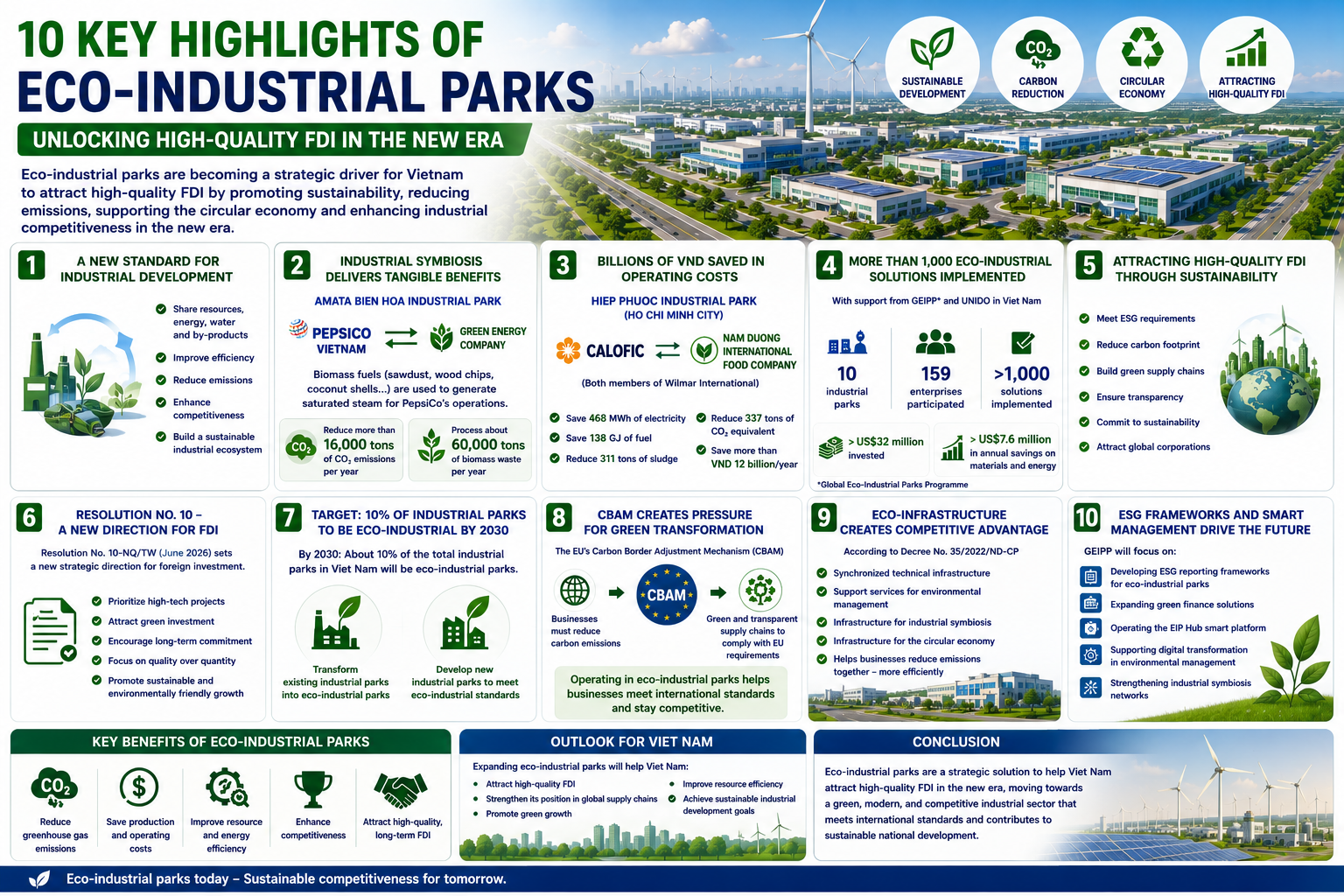
1. Eco-Industrial Parks Are Becoming the New Industrial Development Standard
Rather than simply providing industrial infrastructure, eco-industrial parks create a sustainable industrial ecosystem where businesses share resources, energy, water, and by-products through industrial symbiosis.
This model enables companies to:
- Reduce raw material consumption.
- Improve energy efficiency.
- Lower greenhouse gas emissions.
- Increase production efficiency.
- Strengthen long-term competitiveness.
Many countries are adopting this approach to support green economic development and sustainable manufacturing.
2. Industrial Symbiosis Delivers Tangible Benefits
A leading example is Amata Bien Hoa Industrial Park, where PepsiCo Vietnam collaborates with Green Energy Company to utilize saturated steam generated from biomass fuel.
The biomass fuel includes:
- Sawdust
- Wood chips
- Coconut shells
- Agricultural residues
This solution enables PepsiCo to:
- Reduce more than 16,000 tons of carbon emissions annually.
- Process approximately 60,000 tons of biomass waste each year.
- Replace conventional fossil-fuel-based energy.
The project demonstrates how one company’s waste can become another company’s valuable resource.
3. Saving Billions of Vietnamese Dong in Operating Costs
At Hiep Phuoc Industrial Park in Ho Chi Minh City, the industrial symbiosis model between Calofic and Nam Duong International Food Company has generated substantial economic and environmental benefits.
Each year, the collaboration saves:
- 468 MWh of electricity.
- 138 GJ of fuel.
- 311 tons of sludge waste.
- 337 tons of CO₂ equivalent emissions.
- More than VND 12 billion in operating costs.
These results prove that eco-industrial parks deliver measurable economic value while protecting the environment.
4. More Than 1,000 Eco-Industrial Solutions Have Been Implemented
According to the Global Eco-Industrial Parks Programme (GEIPP), implemented by the United Nations Industrial Development Organization (UNIDO) in Vietnam:
- More than 1,000 industrial efficiency solutions have been deployed.
- Across 10 industrial parks.
- Involving 159 enterprises.
These initiatives have generated:
- More than US$32 million in investment.
- Annual savings exceeding US$7.6 million in raw materials and energy costs.
These achievements clearly demonstrate the effectiveness of eco-industrial park development in Vietnam.
5. Sustainable Development Attracts High-Quality FDI
Today, multinational corporations evaluate investment destinations based not only on cost but also on:
- ESG performance.
- Carbon footprint.
- Green supply chains.
- Environmental transparency.
- Long-term sustainability commitments.
As a result, eco-industrial parks have become highly attractive destinations for high-quality FDI, particularly in high-tech manufacturing, electronics, semiconductors, and green industries.
6. Resolution No. 10 Establishes a New Direction for FDI Attraction
In June 2026, the Political Bureau issued Resolution No. 10-NQ/TW on the development of foreign-invested economic sectors.
The Resolution emphasizes:
- High-tech investment.
- Green industrial development.
- Long-term investment commitments.
- Higher-quality FDI.
- Environmentally sustainable growth.
This marks Vietnam’s strategic transition from attracting investment based primarily on quantity to focusing on investment quality and long-term value.
7. Vietnam Targets 10% Eco-Industrial Parks by 2030
One of the Resolution’s most significant objectives is:
By 2030, approximately 10% of Vietnam’s industrial parks are expected to become eco-industrial parks, including:
- Existing industrial parks undergoing green transformation.
- Newly developed eco-industrial parks.
This target will significantly reshape Vietnam’s industrial development toward sustainability.
8. CBAM Accelerates Green Manufacturing Transformation
The European Union is implementing the Carbon Border Adjustment Mechanism (CBAM).
Under CBAM, exporters to the EU must disclose and account for carbon emissions associated with their products.
Consequently, manufacturers must:
- Reduce greenhouse gas emissions.
- Improve supply chain transparency.
- Adopt cleaner production practices.
Establishing manufacturing facilities within eco-industrial parks provides an effective pathway for companies to comply with these international requirements.
9. Eco-Infrastructure Creates a Competitive Advantage
According to Government Decree No. 35/2022/ND-CP, eco-industrial parks must meet comprehensive standards covering:
- Technical infrastructure.
- Environmental support services.
- Environmental management systems.
- Industrial symbiosis infrastructure.
- Circular economy facilities.
This integrated ecosystem allows businesses to collaborate in reducing emissions rather than addressing sustainability challenges independently.
10. ESG Frameworks and Smart Management Platforms Will Drive Future Growth
According to GEIPP, future priorities include:
- Developing dedicated ESG reporting frameworks for eco-industrial parks.
- Expanding green finance solutions.
- Operating the EIP Hub smart management platform.
- Supporting digital transformation in environmental management.
- Strengthening industrial symbiosis networks.
These initiatives will help Vietnamese industrial parks meet international sustainability standards while improving their global investment competitiveness.
Outlook for Eco-Industrial Parks in Vietnam
As global investment increasingly shifts toward green manufacturing and the circular economy, eco-industrial parks are becoming much more than environmentally friendly industrial zones.
They represent a strategic platform for:
- Increasing production efficiency.
- Reducing operating costs.
- Improving resource utilization.
- Enhancing competitiveness.
- Creating sustainable long-term value.
Expanding Vietnam’s eco-industrial park network will help the country:
- Attract high-quality FDI.
- Strengthen its position in global supply chains.
- Reduce greenhouse gas emissions.
- Modernize industrial production.
- Achieve national green growth and sustainable development goals.
Conclusion
The development of eco-industrial parks is becoming one of Vietnam’s most important strategies for attracting high-quality foreign direct investment in the new era. Supported by successful industrial symbiosis models, the strategic direction of Resolution No. 10-NQ/TW, and the national goal of converting 10% of industrial parks into eco-industrial parks by 2030, Vietnam is well-positioned to build a modern, environmentally sustainable, and globally competitive industrial sector.
References:
Free access to exclusive information on warehouse, factory, and land rentals in Dong Nai, Binh Duong, Long An, Ho Chi Minh City, and more.
KHU CÔNG NGHIỆP 247 is a company operating in the field of buying, selling, and leasing factories and real estate.. We are proud to be a leading provider of real estate services in Vietnam. We have a team of highly qualified and experienced real estate consultants who always place trust and credibility at the core of everything we do.
Phone: 0901 490 348
Email: datkhucongnghiep247@gmail.com
Website: datkhucongnghiep247.com.vn