

As Vietnam targets double-digit economic growth during the 2026–2030 period, aims to become a developing country with a modern industrial base by 2030, and aspires to achieve high-income status by 2045, next-generation industrial parks (IPs) are becoming a cornerstone of the country’s long-term development strategy.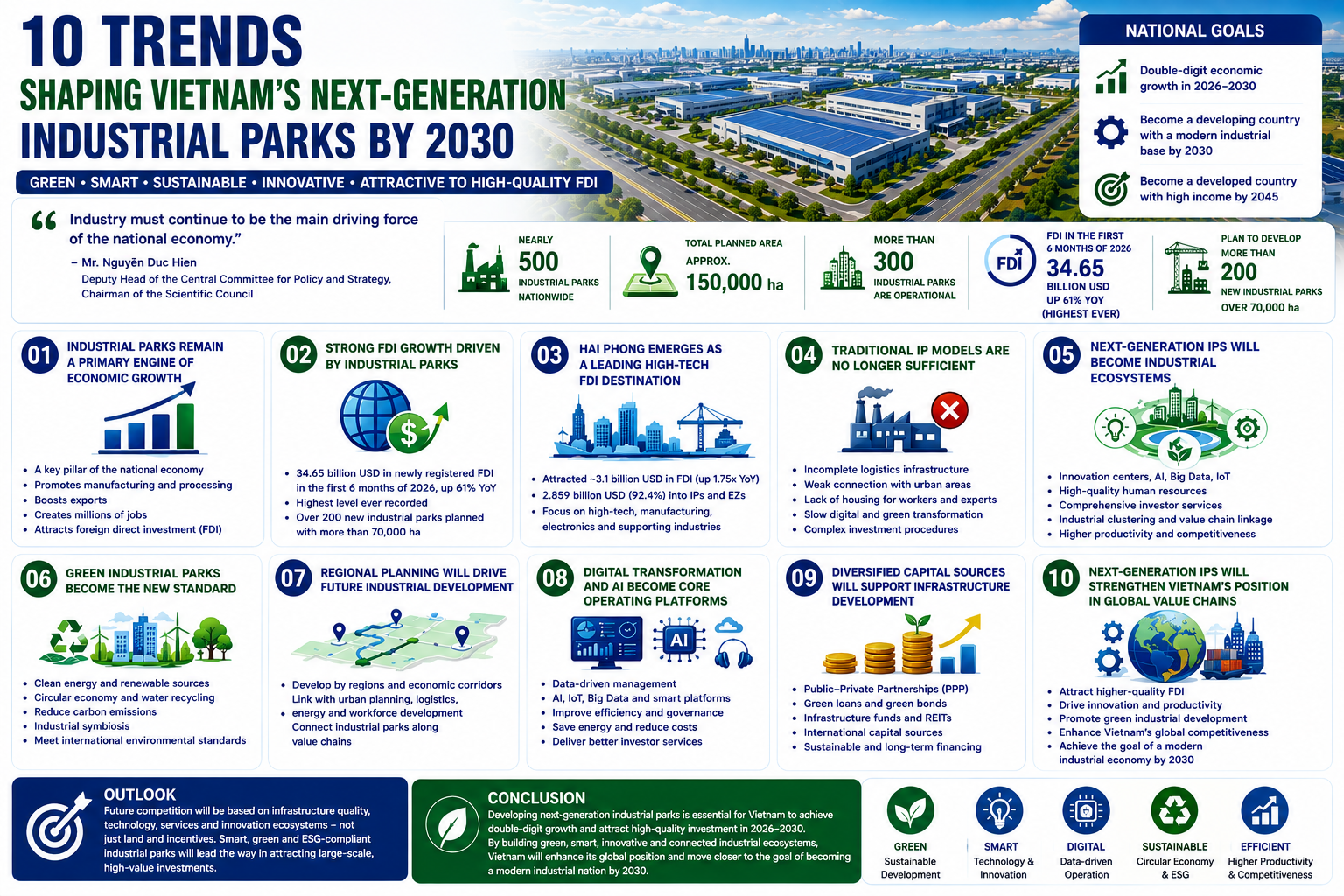
Rather than focusing solely on expansion, Vietnam’s industrial parks are transforming into green, smart, digitally connected, and innovation-driven ecosystems that can attract high-quality foreign direct investment (FDI) while strengthening the country’s position in global supply chains.
1. Industrial Parks Remain a Primary Engine of Economic Growth
After more than three decades of development, industrial parks have become one of Vietnam’s most important economic pillars.
Today, Vietnam has:
- Nearly 500 industrial parks.
- Approximately 150,000 hectares of planned industrial land.
- More than 300 operational industrial parks.
These industrial parks continue to:
- Attract foreign direct investment (FDI).
- Expand manufacturing and processing industries.
- Increase export value.
- Create millions of employment opportunities.
2. Strong FDI Growth Driven by Industrial Parks
During the first six months of 2026, Vietnam recorded approximately US$34.65 billion in newly registered FDI, representing a 61% year-on-year increase and the highest level ever recorded.
This impressive performance has been supported by:
- Rapid industrial park development.
- A stable investment environment.
- Global supply chain diversification toward Vietnam.
- Continued expansion of the manufacturing sector.
Looking ahead, Vietnam plans to develop more than 200 additional industrial parks covering over 70,000 hectares, creating significant opportunities for both domestic and international investors.
3. Hai Phong Emerges as a Leading High-Tech FDI Destination
As one of Vietnam’s largest industrial centers, Hai Phong continues to attract substantial investment.
As of June 25, 2026, the city had attracted approximately US$3.1 billion in FDI, an increase of 1.75 times compared with the same period in 2025.
Among this investment:
- US$2.859 billion (approximately 92.4%) flowed into industrial parks and economic zones.
- Most projects focus on:
- High technology.
- Manufacturing and processing industries.
- Electronics and supporting industries.
These figures demonstrate the growing importance of industrial parks in attracting premium investment projects.
4. Traditional Industrial Park Models Are No Longer Sufficient
According to industry experts, traditional competitive advantages such as:
- Large land reserves.
- Low labor costs.
- Investment incentives.
are no longer enough to attract leading investors.
Many industrial parks still face challenges, including:
- Incomplete logistics infrastructure.
- Weak integration with surrounding urban areas.
- Insufficient housing for workers and experts.
- Slow digital transformation.
- Limited green transformation.
- Lengthy administrative procedures.
Addressing these issues has become essential for maintaining Vietnam’s investment competitiveness.
5. Next-Generation Industrial Parks Will Become Integrated Industrial Ecosystems
Vietnam’s future industrial parks are expected to evolve far beyond traditional manufacturing zones.
They will integrate:
- Innovation centers.
- Artificial Intelligence (AI).
- Big Data analytics.
- Internet of Things (IoT).
- Highly skilled human resources.
- Comprehensive business support services.
This ecosystem approach will encourage industrial clustering, improve productivity, and enhance national competitiveness.
6. Green Industrial Parks Become the New Standard
The transition toward eco-industrial parks is accelerating across Vietnam.
Successful examples include:
- Nam Cau Kien Industrial Park.
- DEEP C Industrial Park.
- Dinh Vu Industrial Park.
- Hoa Khanh Industrial Park.
- Amata Bien Hoa Industrial Park.
- Phu My 3 Specialized Industrial Park.
These developments emphasize:
- Renewable and clean energy.
- Circular economy principles.
- Water recycling.
- Carbon emission reduction.
- Industrial symbiosis.
Such initiatives provide a strong foundation for attracting multinational corporations seeking sustainable investment locations.
7. Regional Planning Will Drive Future Industrial Development
Experts believe industrial park planning should shift from isolated development toward integrated regional strategies involving:
- Regional economic corridors.
- Industrial value chains.
- Logistics networks.
- Smart urban planning.
- Human resource development.
Better regional coordination will improve connectivity and strengthen industrial competitiveness.
8. Digital Transformation and AI Become Core Operating Platforms
Next-generation industrial parks will increasingly rely on digital technologies for daily operations.
Key technologies include:
- Artificial Intelligence (AI).
- Internet of Things (IoT).
- Big Data.
- Smart operation centers.
- Digital governance platforms.
These technologies help industrial parks:
- Reduce energy consumption.
- Lower operating costs.
- Improve operational efficiency.
- Deliver better investor services.
9. Diversified Capital Sources Will Support Infrastructure Development
Developing more than 200 new industrial parks will require infrastructure investment worth tens of billions of US dollars.
To meet this demand, Vietnam is expected to mobilize funding through:
- Public-Private Partnerships (PPP).
- Green financing.
- Green bonds.
- Infrastructure investment funds.
- Real estate investment funds.
- International capital sources.
Diversified financing will accelerate industrial infrastructure development while ensuring long-term sustainability.
10. Next-Generation Industrial Parks Will Strengthen Vietnam’s Global Position
Transforming industrial parks into modern industrial ecosystems will deliver multiple strategic benefits:
- Attract higher-quality FDI.
- Promote innovation.
- Increase labor productivity.
- Support green industrial development.
- Enhance Vietnam’s role in global supply chains.
These changes will help Vietnam achieve its goal of becoming a modern industrial economy by 2030.
Outlook for Vietnam’s Next-Generation Industrial Parks
As global competition for investment intensifies, industrial parks will compete not only through land availability or tax incentives but also through:
- Modern infrastructure.
- Digital technologies.
- High-quality investor services.
- Sustainable industrial ecosystems.
- ESG-compliant operations.
Industrial parks that successfully integrate smart technologies, environmental sustainability, and innovation will enjoy a significant competitive advantage in attracting large-scale, high-value manufacturing investments.
Conclusion
The development of next-generation industrial parks is essential for Vietnam to maintain rapid economic growth while improving the quality of investment attraction throughout the 2026–2030 period. By building green, smart, digitally connected, and innovation-driven industrial ecosystems, Vietnam is creating new competitive advantages that will strengthen its position in global value chains, attract world-class investors, and support sustainable industrial development for decades to come.
References:
Free access to exclusive information on warehouse, factory, and land rentals in Dong Nai, Binh Duong, Long An, Ho Chi Minh City, and more.
KHU CÔNG NGHIỆP 247 is a company operating in the field of buying, selling, and leasing factories and real estate.. We are proud to be a leading provider of real estate services in Vietnam. We have a team of highly qualified and experienced real estate consultants who always place trust and credibility at the core of everything we do.
Phone: 0901 490 348
Email: datkhucongnghiep247@gmail.com
Website: datkhucongnghiep247.com.vn