


Vietnam Real Estate Market Shows Positive Signs but Challenges Remain
At the Vietnam Real Estate Forum 2026, held under the theme “The Real Estate Market in a New Growth Model: Unlocking Resources – Creating Development Space – Supporting National Growth Goals,” Deputy Minister of Construction Nguyen Van Sinh stated that Vietnam’s real estate market has shown encouraging signs of recovery after a prolonged period of challenges.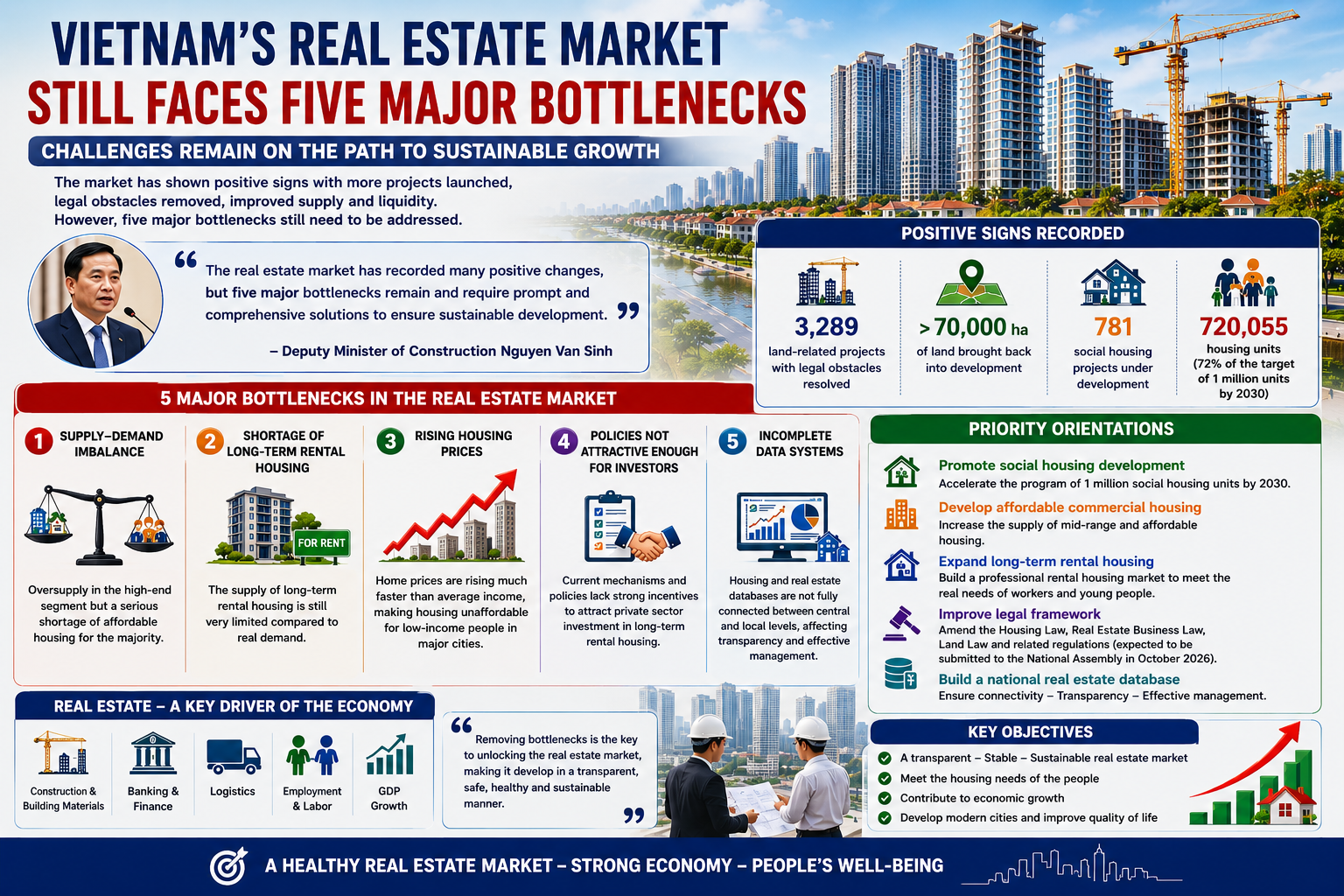
Many large-scale projects have been launched, numerous projects facing legal obstacles have resumed development, housing supply has gradually improved, and market liquidity has recovered significantly. However, for the real estate sector to become a sustainable driver of economic growth, several long-standing issues still need to be addressed.
More Than 3,200 Real Estate Projects Have Had Legal Obstacles Resolved
According to the Ministry of Construction, the Government, National Assembly, and relevant ministries have implemented various measures to unlock resources and support the recovery of the real estate market.
Key achievements include:
- 3,289 land-related projects have had legal and administrative issues resolved.
- More than 70,000 hectares of land have been brought back into development.
- Projects worth millions of billions of Vietnamese dong have resumed implementation.
- Numerous large-scale projects have received investment approval and construction permits.
Regarding social housing development:
- 781 social housing projects are currently under development.
- Total scale reaches 720,055 housing units.
- Equivalent to 72% of the national target of one million social housing units by 2030.
These achievements provide an important foundation for increasing housing supply and stabilizing the market in the long term.
Five Major Bottlenecks in Vietnam’s Real Estate Market
Despite positive progress, the Ministry of Construction identified five major challenges that continue to hinder sustainable market development.
1. Imbalance Between Housing Supply and Actual Demand
One of the most significant issues is the mismatch between supply and demand.
While luxury apartments, villas, and high-end real estate projects continue to expand, there is a severe shortage of housing that is affordable for the majority of Vietnamese households.
This imbalance prevents the market from fully meeting real housing needs.
2. Insufficient Long-Term Rental Housing
Vietnam’s real estate market remains heavily focused on:
- Commercial housing
- Properties for sale
- Investment-oriented real estate
Meanwhile, long-term rental housing, which serves workers, young professionals, and low-income residents, remains significantly underdeveloped.
This is considered one of the largest gaps in Vietnam’s housing market today.
3. Housing Prices Continue to Rise Rapidly
Housing prices in major cities have increased dramatically in recent years.
The growth rate of property prices has far exceeded the increase in average household income.
As a result:
- Young people face difficulties buying homes.
- Low-income workers struggle to access housing.
- Homeownership gaps continue to widen.
This poses a major challenge to social welfare and sustainable urban development.
4. Policies Are Not Attractive Enough for Rental Housing Investment
According to the Ministry of Construction, current policies do not provide sufficient incentives for private investors to develop long-term rental housing projects.
Major obstacles include:
- Long investment payback periods
- Lower profit margins
- Limited tax incentives
- Restricted access to land resources
- Difficulties in obtaining long-term financing
As a result, many developers still prioritize housing projects for sale rather than rental housing.
5. Real Estate Data Systems Remain Incomplete
Another significant bottleneck is the lack of integration between housing and real estate databases at central and local government levels.
The absence of a unified information system creates:
- Challenges for government management
- Limited market transparency
- Reduced forecasting capabilities
- Increased risks of speculation and local property bubbles
Digital transformation and the development of a national real estate database have become urgent priorities.
Social Housing and Rental Housing Will Be Future Priorities
According to the Government and the Ministry of Construction, future market development will focus on housing segments that serve genuine residential demand.
Social Housing
- Accelerating the One Million Social Housing Units Program.
- Increasing housing supply for low-income households.
- Supporting workers in industrial zones.
Affordable Commercial Housing
- Balancing housing supply structures.
- Reducing overdevelopment of luxury segments.
- Expanding middle-income and affordable housing options.
Rental Housing
- Encouraging long-term investment.
- Developing a professional rental housing market.
- Meeting the needs of young workers and urban residents.
Amendments to Housing and Real Estate Laws
To remove existing bottlenecks, the Ministry of Construction is working with relevant agencies to amend:
- The Housing Law
- The Real Estate Business Law
- The Land Law
- Other related legal regulations
The proposed amendments are expected to be submitted to the National Assembly during the October 2026 session.
The goal is to establish a transparent, stable, and efficient legal framework that benefits both businesses and homebuyers.
Real Estate Remains a Key Driver of Economic Growth
According to the Ministry of Construction, real estate is not merely a business sector but also an industry with strong spillover effects across the economy, including:
- Construction
- Building materials
- Banking and finance
- Logistics
- Services
- Employment and labor markets
Removing existing bottlenecks will help unlock investment resources, stimulate GDP growth, support modern urban development, and enhance Vietnam’s national competitiveness.
Conclusion
Vietnam’s real estate market in 2026 is showing clear signs of recovery through improved supply, stronger liquidity, and a more supportive legal environment. However, five major bottlenecks—supply-demand imbalance, shortage of rental housing, rapidly rising home prices, insufficient investment incentives, and incomplete market data systems—continue to challenge sustainable growth.
Accelerating social housing development, expanding rental housing supply, and improving the legal framework will be crucial to building a transparent, healthy, and sustainable real estate market that can serve as a long-term engine for Vietnam’s economic growth.
References:
Free access to exclusive information on warehouse, factory, and land rentals in Dong Nai, Binh Duong, Long An, Ho Chi Minh City, and more.
KHU CÔNG NGHIỆP 247 is a company operating in the field of buying, selling, and leasing factories and real estate.. We are proud to be a leading provider of real estate services in Vietnam. We have a team of highly qualified and experienced real estate consultants who always place trust and credibility at the core of everything we do.
Phone: 0901 490 348
Email: datkhucongnghiep247@gmail.com
Website: datkhucongnghiep247.com.vn